
How to Use Sensory Bins to Build Communication and Social Skills (Plus 50+ Filler Ideas!)
Everyone knows what a sensory bin is. But did you know these fun sensory exploration tools can be used to practice and build important communication and social skills?
And the best part? You probably already have everything you need to get started at home!
If you’ve ever watched your child get completely absorbed exploring different textures, you’ve witnessed the magic of sensory learning in action.
These simple containers filled with interesting materials can help; you turn play into opportunities for growth and connection.
What Makes Sensory Bins So Effective for Skill Building?
Sensory bins work because they naturally engage children in a way that feels like play. When kids are relaxed and interested, they’re more likely to communicate, interact, and learn.
Here’s what makes them special:
- They provide novel textures that capture attention naturally
- Children can explore at their own pace without pressure
- The materials invite interaction and shared experiences
- They’re flexible enough that you can create them to match any child’s interests or developmental level
Whether your child seeks out tactile input or tends to avoid new textures, sensory bins can be adapted to meet them exactly where they are.
Following Your Child’s Lead: The Foundation of Success
The most important rule for using sensory bins? Always follow your child’s lead.
Some kids will dive right in with both hands, eager to explore and get messy. Other kids will be more hesitant and prefer to watch you play first.
Both approaches are perfectly fine!
If your child doesn’t want to touch the materials directly, let them:
- Watch you explore and narrate what you’re doing
- Use tools like spoons, tongs, or small scoops
- Drop items in from a distance
- Point to things they find interesting
Remember, there’s no “wrong” way to use a sensory bin..
Building Joint Attention Through Sensory Play
Joint attention is when two or more people share focus on the same thing. It often includes communicative gestures like pointing and gaze following, which are natural ways we direct each other’s attention.
It’s a social skill that allows people to share experiences with each other.
For a parent and child, joint attention happens when you’re both focused on the same object or activity, and you’re communicating about it together.
It’s different from your child just looking at something while you happen to be nearby. True joint attention involves that back-and-forth connection—your child might point to something interesting, look at you to make sure you see it too, then look back at the object as you both share that moment of discovery.
Why is joint attention so important?
Think of it as the foundation for all social communication. Before kids even learn to talk, they learn to share experiences. Joint attention is how they discover that other people have thoughts and feelings about the same things they do.
It’s the beginning of a real connection and the stepping stone to more complex social skills.
What joint attention looks like
- Your child points to a bird outside, then looks at you to see your reaction
- They hand you a toy and wait to see what you’ll do with it
- They look back and forth between you and something that caught their interest
- They follow your gaze when you look at something and say, “Look!”
Why some children find joint attention challenging
For neurodivergent children, the world can feel overwhelming or unpredictable.
When kids are constantly working hard to process sensory information or manage big emotions, it can be really hard for them to also pay attention to what someone else is thinking or feeling.
This doesn’t mean that neurodivergent kids don’t want to connect—they just might need extra support to make those connections feel safe and manageable.
How sensory bins create natural opportunities for joint attention
Sensory bins are a low-pressure way to create opportunities for shared focus between you and your child (or their siblings or friends).
When your child discovers something they find fascinating in the bin, their natural instinct is often to share that discovery with others.
Here’s how to encourage them:
- Use simple language to narrate what’s happening:
- “Look! The feathers are falling!”
- “I found a red pom-pom!”
- “This feels bumpy!”
- Follow their gaze and interests:
- If they’re fascinated by the way rice falls through their fingers, join them in that exploration
- Comment on what they’re discovering: “You found all the blue buttons!”
- Create anticipation and excitement:
- Hold feathers up high and drop them slowly
- Hide favorite items for them to “discover”
- Use animated facial expressions and voice
These shared moments of discovery build the foundation for back-and-forth communication.
Encouraging Reciprocal Play and Turn-Taking
Reciprocal play is term used for back-and-forth interaction between two or more people during play. It involves taking turns, responding to each other’s actions, and building on what the other person is doing.
This type of play is a great way to develop social skills because it involves engaging with others, reading social cues, and participating in the give-and-take interactions that are a part of all types of relationships.
As a parent playing with your child, reciprocal play might look like rolling a ball back and forth, taking turns adding blocks to a tower, or copying each other’s silly faces. The key is that both people are actively participating and responding to what the other person does—it’s a true interaction, not just playing side by side (parallel play).
Sensory bins offer countless opportunities for this important back-and-forth interaction.
Techniques for Encouraging Reciprocal Play with Sensory Bins
- Hand-me games: Your child finds items and hands them to you, then you can hand them back or help them sort
- Copy games: Mirror what your child is doing, then wait to see if they’ll copy you back
- Drop and watch together: Take turns dropping feathers or pom-poms and watching them fall
- Fill and dump: Children pour materials into containers while you hold them, then you can help them dump and start again
Basically, look for natural opportunities for your child to initiate the interactions (words, gestures, actions, eyegaze) and then respond to them enthusiastically to keep the ‘conversation’ going.
Communication Opportunities in Every Scoop
Sensory bins are communication goldmines.
Every interaction is a chance to model language, encourage requests, and celebrate attempts at communication.
Model simple words and phrases:
- “More!” when adding materials
- “All done!” when finishing
- “Wow!” for exciting discoveries
- “Help!” when they need assistance
Encourage requests through:
- Pausing with materials just out of reach
- Holding containers they want to use
- Waiting expectantly when they look at you
Celebrate all forms of communication:
- Pointing, gesturing, and reaching are all valid communication
- Eye contact and shared smiles count too
- Any sound or word attempt deserves enthusiastic recognition
Creating Your Own Sensory Bin: It’s Easier Than You Think
As Stephanie shows in her video above, you don’t need to spend a fortune or make it complicated. A simple container from your kitchen and a few household items can create hours of engaging play.
Start with a container:
- Plastic storage boxes work perfectly
- Large mixing bowls for smaller bins
- Even a muffin tin for individual exploration
Choose your base materials: Think about textures that might appeal to your child, but don’t worry about getting it “perfect.” You can always try something different next time.
50+ Sensory Bin Filler Ideas to Try
Base Fillers:
- Rice (white, brown, or colored with food coloring)
- Beans (kidney, black, pinto, navy, or lima beans)
- Pasta shapes (penne, rotini, shells, bow ties)
- Kinetic sand or regular play sand
- Shredded paper or newspaper
- Water beads (for supervised play with older children)
- Oatmeal or cereal
- Popcorn kernels (unpopped)
- Aquarium gravel
- Craft sand or colored sand
Textural Add-ins:
- Feathers of different sizes and colors
- Pom-poms in various sizes
- Cotton balls or cotton pads
- Fabric squares or ribbon scraps
- Foam pieces or shapes
- Sponge pieces cut into fun shapes
- Pipe cleaners
- Yarn or string pieces
- Velcro strips
- Textured fabric samples
- Rubber bouncy balls
- Stress balls or fidget toys
Natural Materials:
- Smooth shells and river rocks
- Pinecones and acorns
- Dried corn kernels
- Birdseed (unsalted)
- Large buttons or wooden beads
- Twigs and small branches
- Dried leaves
- Sand dollars
- Smooth pebbles
- Large seeds (sunflower, pumpkin)
Household Items:
- Wooden blocks or dominoes
- Plastic bottle caps
- Paper cups or egg cartons
- Toilet paper tubes cut into rings
- Ice cube trays for sorting activities
- Wooden spoons and kitchen utensils
- Small containers with lids
- Cardboard pieces
- Aluminum foil balls
- Mesh produce bags
- Old CDs or DVDs
- Cookie cutters
Dollar Store Finds:
- Small figurines and toys
- Stretchy toys and textured balls
- Plastic easter eggs
- Small containers and measuring cups
- Foam letters or numbers
- Plastic animals or vehicles
- Mini flashlights
- Magnifying glasses
- Small puzzle pieces
- Plastic jewelry
- Mini notebooks
- Crayons or markers
Themed Bins Based on Your Child’s Interests:
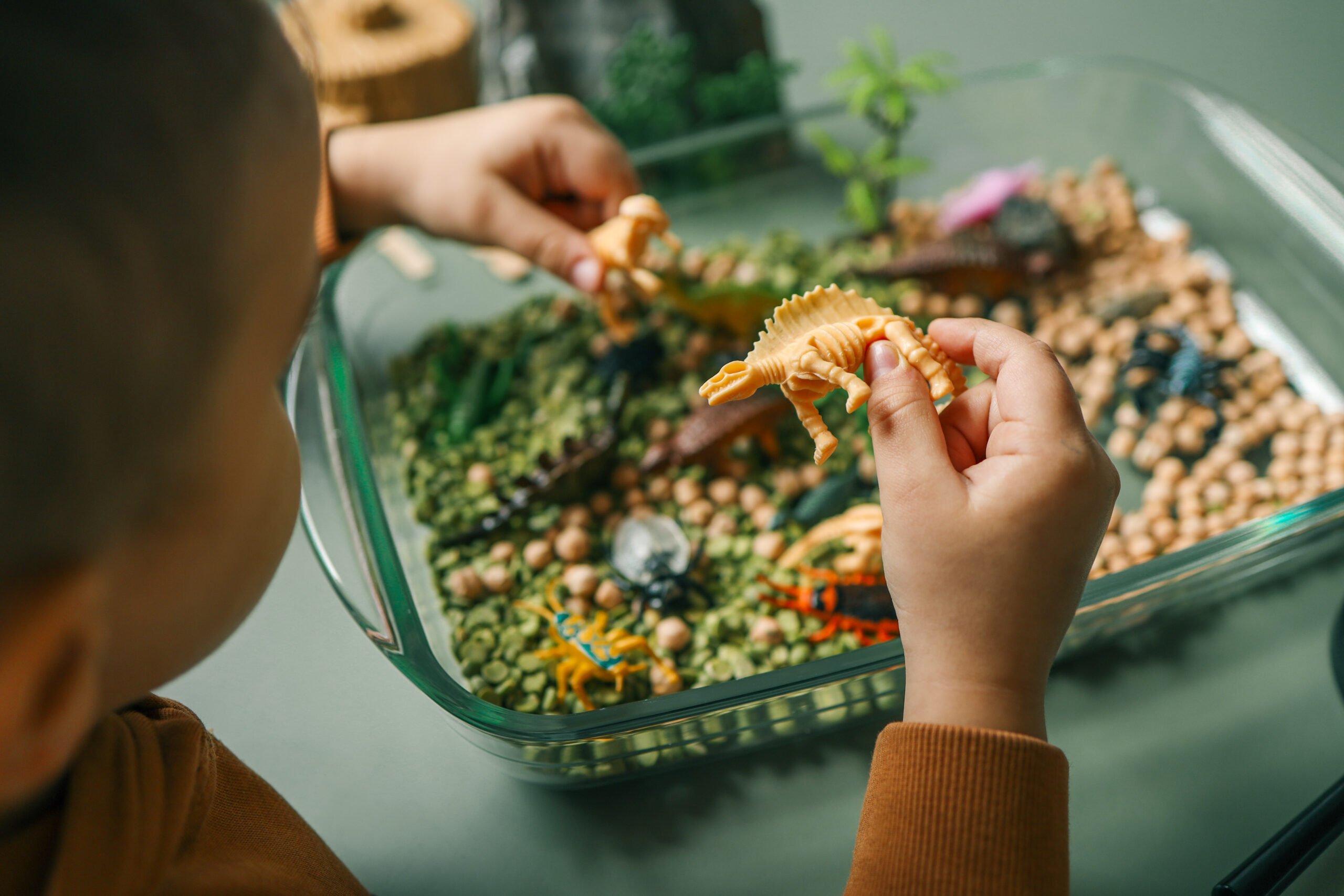
- Dinosaurs: small dinosaur figures, “fossil” rocks, artificial plants, sand
- Vehicles: toy cars, trucks, planes, road signs, black beans as “roads”
- Ocean: shells, blue-tinted rice, sea creature figures, water beads
- Farm: farm animals, dried corn, small hay pieces, wooden blocks as “barns”
- Space: metallic pom-poms, star shapes, black beans as “space rocks”, foil pieces
- Construction: small bulldozers, rocks, sand, cardboard pieces as “building materials”
- Princess/Fairy: sparkly pom-poms, ribbons, plastic gems, feathers
- Kitchen/Cooking: measuring cups, wooden spoons, pasta shapes, beans
- Garden: artificial flowers, green rice, small pots, smooth stones
Making Sensory Bins Work for Different Sensory Needs
Every child has unique sensory preferences.
Here are some tips for adapting your sensory bins based on those preferences:
For children who seek sensory input
- Include materials with strong or novel textures
- Add movement elements like items to pour and dump
- Use larger containers (like a kiddie pool) for full-body exploration
For children who are sensitive to textures
- Start with familiar materials
- Provide tools for exploration instead of direct touch
- Include calmer textures like soft fabric or smooth wooden items
- Follow their lead and let them explore cautiously
- Play with the sensory bin yourself and narrate what you’re feeling without forcing them to join
For children still developing motor skills
- Choose larger items that are easier to grasp
- Include containers with wide openings
- Provide tools with chunky handles
Safety First: Important Reminders
Always supervise sensory bin play, especially with:
- Small items that could be choking hazards
- Children who tend to put things in their mouths
- Water beads or other materials that expand when wet
Choose age-appropriate materials:
- Larger items for children under 3
- Avoid items smaller than a toilet paper tube opening
- Consider your child’s individual development and safety needs
When to Expect Progress (And When Not to Worry)
Skills develop at different rates for every child. Some kids might start communicating more after just a few sensory bin sessions with you, while others need more time.
Look for small wins
- Increased willingness to explore
- More eye contact during play
- Any attempts at communication, even non-verbal
- Longer attention spans during sensory activities
- Initiating interaction or requesting materials
Remember, the goal isn’t perfection—it’s connection and growth at your child’s own pace.
Making It a Regular Part of Your Routine
The beauty of sensory bins is their flexibility. You can:
- Set up a new bin weekly with different themes
- Rotate materials to keep things fresh
- Create smaller “mini bins” for quick sensory breaks
- Let your child help choose and set up materials
Pro tip: Take photos of combinations your child particularly enjoys, so you can recreate successful bins later.
Building Skills Through Play, One Scoop at a Time
Sensory bins prove that the best learning happens when kids are engaged, relaxed, and having fun. These simple containers create natural opportunities for communication, social connection, and skill development—all while your child thinks they’re just playing.
You can get started using whatever materials you have in your home.
The feathers might end up scattered across your living room, and the rice might find its way into unexpected corners, but the connections you’re building and the skills you’re nurturing make every grain worth it.
