
When Brushing Teeth Feels Like a Battle: Strategies for Sensory-Sensitive Kids
Getting your kids to brush their teeth shouldn’t feel like a battle, but for many parents, it does.
If your child refuses to brush their teeth, melts down at the mere mention of a toothbrush, gags when toothpaste touches their tongue, or fights you every single morning and night… you’re not alone. This is a challenge that so many families experience.
But what if I told you that you’re not dealing with defiance or stubbornness? What you’re dealing with is a genuinely complex skill that challenges multiple areas of development all at once.
In this article, we’ll explore why toothbrushing can feel so overwhelming for some kids, practical ways to reduce daily stress around this routine, and how to help your child feel more comfortable and confident with oral care.
Disclaimer: This article contains affiliate links.
What You’re Really Working Toward
If you’re reading this article, you already know that brushing your teeth is important for preventing cavities.
The last thing you need is another lecture about dental hygiene when you probably already feel guilty for struggling this much to get your child to brush their teeth.
We’re going to reframe what success means and cover some strategies to reduce the daily struggle.
- Reducing Daily Stress and Conflict:
Right now, getting your child to brush their teeth might be the worst part of their day (and yours). You don’t need to aim for perfect oral hygiene right away – the goal is getting your child to participate in some form of oral care without major meltdowns. Success is when the routine feels manageable (hopefully even positive) instead of traumatic. - Building Your Child’s Confidence:
Every small positive step builds your child’s confidence in their ability to take care of their body. Success looks like your child feeling capable and even a little proud of participating in their own self-care, even when they need lots of support to get there. - Creating Routines That Actually Work:
You need an approach that accommodates and respects your child’s sensory needs and preferences while still protecting their oral health. Success means creating a sustainable routine that works for your specific child and family rather than trying to force a routine that looks like everyone else’s. - Protecting Your Relationship:
Daily battles over basic care tasks can seriously strain your relationship with your child. Success means your child trusts that you understand their needs and will help them feel safe during care routines, rather than feeling like you’re the enemy who forces uncomfortable things on them.
So, the goal isn’t perfection.
The goal is progress that you can actually live with.
Why Brushing Teeth Is So Challenging for Some Kids
Toothbrushing pulls together multiple skills that are all still developing in young children:
- Motor Skills: Fine motor control, using both hands together, coordinating tongue and cheek movements, and visual-motor integration.
- Cognitive Skills: Remembering the sequence of steps, holding instructions in mind while doing them, understanding timing, and staying focused.
- Sensory Processing: Managing textures, tastes, temperatures, pressure, and all the sensations happening in the mouth at once.
- Emotional Factors: Need for autonomy and control, anxiety around oral care, past negative experiences with forced brushing or dental visits, difficulty with transitions and routine changes.
When you think about everything that has to work together, it’s no wonder some kids find it overwhelming.
Remember: Progress Over Perfection
For kids who are struggling with sensory challenges:
- Getting the toothbrush to touch most surfaces of the teeth is a huge success.
- 30 seconds of cooperative brushing is better than 2 minutes of fighting.
- Some cleaning is infinitely better than no cleaning.
- Your child’s comfort and willingness to try again tomorrow matters way more than brushing their teeth perfectly today.
When Sensory Processing Makes Brushing Teeth Overwhelming
The mouth is packed with sensitive nerve endings, and for some kids, this sensitivity creates genuine challenges during toothbrushing.
Some of the ways that sensory processing differences impact brushing your teeth include:
Oral Hypersensitivity
When a child has “oral hypersensitivity,” their mouth processes sensations much more intensely than typical.
What feels like gentle pressure to you might feel uncomfortable or even painful to them.
The bristles of the toothbrush can feel scratchy or sharp (even if you have a soft-bristled brush), the water temperature may feel extreme, and they may gag from sensations that don’t bother other kids.
Texture and Taste Challenges
Some children have strong reactions to the texture of toothpaste (especially foaming), mint flavors can be overwhelming, and there can be lingering aftertastes (which also make food taste different).
They could also be sensitive to artificial sweeteners in the toothpaste, or find the wet-to-dry sensation as saliva and toothpaste mix to be uncomfortable.
Pressure and Positioning Difficulties
Some children struggle with knowing how much pressure to use, have trouble with the physical positioning required for brushing, or have a sensitive gag reflex that’s triggered easily.
Sensory Overload
This isn’t about being ‘difficult’, ‘stubborn’ or ‘defiant’. Your child may be avoiding or refusing to brush their teeth because their sensory processing differences are causing sensory overload.
When you add up all these sensations happening simultaneously: toothpaste foam, bristle textures, taste, smell, and positioning, plus factor in the bathroom lighting, running water noises, etc… it’s easy to see how a child’s nervous system can become completely overwhelmed, leading to meltdowns, anxiety, or complete shutdown.
The goal isn’t to make your child “tolerate” overwhelming sensations – it’s to understand their needs and find accommodations that will make oral care feel safe and manageable for them.
Strategies for Tooth Brushing Success
Build Comfort First by Starting Outside of the Mouth
This is where occupational therapist Stephanie Dorgan’s approach becomes so valuable for struggling families.
The key to this approach is exposing children to the activity of brushing their teeth at hand level in a fun and stress-free way before expecting struggling kids to put a toothbrush in their mouth. For many children, having something in their mouth can feel vulnerable and scary, especially if they’ve had negative experiences with oral care in the past.
Stephanie’s Mr. Potato Head method works because it allows kids to practice and build positive associations with oral care without any of the overwhelming sensory input or vulnerability of having something in their mouth.

Stephanie’s Mr. Potato Head Method
- Draw ‘plaque’ on Mr. Potato Head’s teeth using washable markers
- Use shaving cream as “toothpaste” on a real toothbrush
- Let kids brush the marker off the toy teeth
- Make the whole experience playful and pressure-free
Why This Works for Sensory-Sensitive Children
- Sensory exploration without overwhelm: Kids can explore bristle textures and “toothpaste” at their own pace, in complete control.
- Motor skill development: Children practice brushing movements without the added challenge of coordinating their mouth position.
- Positive associations: When brushing becomes fun first, kids develop positive feelings about the tools and process instead of associating toothbrushes with struggle.
- Building confidence: Success with the toy version builds confidence that carries over to real oral care.
- Understanding cause and effect: Children can clearly see the ‘plaque’ disappearing as they brush, helping them understand what brushing their teeth accomplishes.
Allow your child to spend as much time as needed with this step.
Some kids might be ready to try brushing their own teeth after one session, while others may need plenty of time to practice with Mr. Potato Head again and again before they feel comfortable putting the toothbrush in their mouth.
Rebuilding Trust After Negative Experiences
If your child has had traumatic experiences with oral care, rebuilding trust takes time and patience:
- Give your child as much control as possible – let them choose the toothbrush, toothpaste flavor, music, etc.
- Start very small and build gradually – even just holding a toothbrush is progress.
- Never force or hold your child down for brushing, as this creates more negative associations.
- Consider taking a complete break from traditional brushing and focusing only on play-based activities like Mr. Potato Head for a while.
- Acknowledge and validate their feelings: “I know brushing teeth feels scary. We’re going to find a way that feels safe for you.”
Use Visual Supports
Many children benefit from visual reminders that break down the steps of brushing their teeth into simple, easy-to-follow steps with pictures.
Visual supports can help kids understand what’s expected, feel more independent, and reduce anxiety about the routine.
Download our free printable visual guide that shows the basic steps for brushing your teeth.
You can hang this in your bathroom at your child’s eye level so they can follow along:
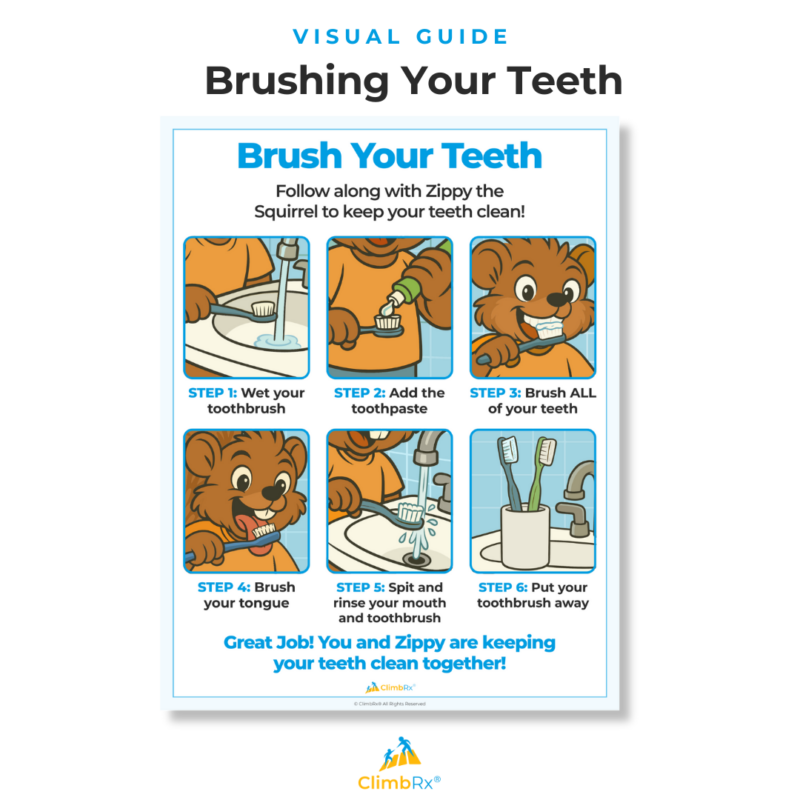
Brushing Your Teeth Visual Guide
A step-by-step visual guide that makes tooth brushing clear and manageable for kids. Features Zippy the Squirrel demonstrating each step, perfect for building independence and reducing overwhelm around daily hygiene routines.
Basic Steps for Brushing Your Teeth:
- Wet the toothbrush: Use lukewarm water that feels comfortable
- Apply toothpaste: A grain-of-rice sized amount for children under 3, pea-sized for older kids
- Start with the front teeth: These are easiest to reach and see
- Brush up and down: Follow the way teeth grow – up on bottom teeth, down on top teeth
- Cover all surfaces: Outside, inside, and chewing surfaces of all teeth
- Don’t forget the tongue: A gentle brush helps remove bacteria
- Rinse and spit: Help younger children learn to spit out toothpaste rather than swallow
Brush Your Teeth Songs
Music can help kids understand the timing and process, and make brushing their teeth more enjoyable.
Look for ‘brush your teeth’ songs on YouTube or ask your Amazon Alexa to play a toothbrushing song.
Let your child pick their favorite song or use the same one consistently to build routine familiarity.
Tools and Alternatives for Kids
Every child processes sensory information differently, so experiment to find what works for your specific child.
Here are some possible tools and alternatives you can try. Just remember that everybody is different, and you know your child best.
Specialized Toothbrushes
- 3-sided toothbrushes: Clean all tooth surfaces simultaneously, reducing brushing time, though for very sensitive mouths, the extra bristle contact might feel more overwhelming. There are electric options – like this one and manual options – like this.
- U-shaped toothbrushes: Willo Kids U-shaped brush is a gentle and fully automated tooth-brushing system for kids. These can work great for kids whose motor skills and planning are impacting their technique, but, like the three-sided brush, may be more overwhelming for kids with sensory sensitivities.
- Extra-soft or natural bristles: For children sensitive to standard bristle textures
- Vibrating sensory toothbrushes: Some kids find the vibration calming
- Different handle sizes: Thicker or thinner grips for easier handling. There are also universal gripping tools available that you can use to create a wider surface for kids to hold.
- Finger brushes: These are soft silicone covers for your finger, typically used for babies, but could be a helpful stepping stone for kids with sensory sensitivities. Kids can use it on their own fingers, giving them control over pressure and movement. Not a long-term solution, but it could work as a stepping stone.
Toothpaste Alternatives
- Training toothpaste: Milder flavors, less foaming
- Different flavors: Strawberry, bubblegum, or unflavored instead of mint
- Tooth gels: Different texture than traditional paste
Environmental Modifications
- Timing: Try different times of day
- Lighting: Dimmer lighting may feel less overwhelming
- Position: Sitting, standing on a stool, or in different locations
- Music and timers: Visual timers, apps like “Brush DJ,” or character-shaped timers
Every child is different, so keep in mind that what works for one child might not help another. The goal is to find solutions that help your child.
When Should Kids Start Brushing Independently?
Individual differences matter much more than universal age timelines.
While dental professionals often suggest independence around age 6-8, this assumes typical sensory processing and motor development.
Consider these factors instead of age:
- Sensory comfort with the process
- Motor skills to handle the toothbrush effectively
- Ability to focus on the task
- Emotional regulation during the routine
Sometimes it’s better for parents to help longer if it means the child stays calm, teeth get clean, and the experience remains positive. A 10-year-old who needs help but cooperates happily is in a much better place than an 8-year-old who fights brushing daily.
On the flip side, sometimes it’s better for kids to take over independently sooner if it means they’re willing to participate. Some children have strong needs for autonomy and don’t want someone doing something to them. A 2-year-old who happily brushes their own teeth (even imperfectly) is in a much better place than if they’re melting down while a parent forcefully brushes their teeth properly.
Supporting Your Child’s Journey
Learning oral care is a process that different kids will move through at different paces.
- Follow your child’s lead: If they’re interested in exploring, encourage that. If they need breaks, respect that too.
- Redefine success: Holding a toothbrush is progress. Staying calm during the routine is progress. Any step forward deserves recognition.
- Stay flexible: What works today might not work tomorrow. Adjust as your child grows and changes.
- Focus on the relationship: Your relationship with your child is more important than perfect oral hygiene.
- Trust your instincts: You know your child best. If an approach doesn’t feel right for your child, don’t use it.
- Remember that accommodating sensory needs isn’t “giving in”: Finding ways to make oral care comfortable for your child is actually the most effective approach for long-term success.
- Partner with professionals when needed: If you’re really struggling to get your child to brush their teeth, occupational therapists and dentists specializing in neurodivergent children can provide additional support.
This challenging phase won’t last forever. Children who struggle early often become completely independent with oral care as they mature, especially when their early experiences focus on safety, comfort, and positive associations.
The path to successful oral care might look different for your child, and that’s perfectly okay.
When we meet children where they are and build from there, we give them the best foundation for long-term success while preserving their trust and well-being.
This article was written by Nicole Day and reviewed for clinical accuracy by Stephanie Dorgan, Occupational Therapist.
