Skip to content
Think Sensory
Join
Login
Shopping Cart 0
Shopping Cart 0
Think Sensory
Join
Login

You may be interested in…

Your cart is currently empty!


New in store

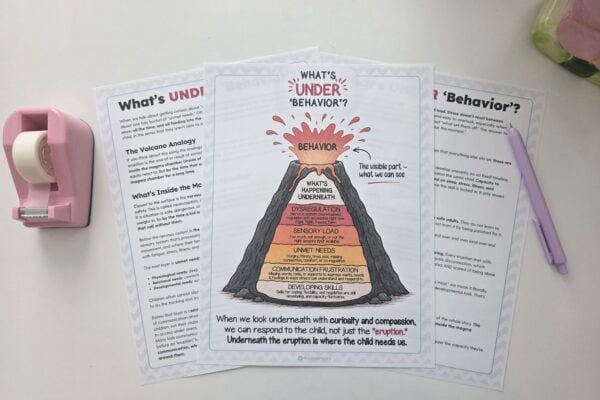
  • "A photo of three printed Think Sensory resource pages fanned out on a white surface, with a pink tape dispenser and a purple pen visible nearby. The center page is fully visible and titled 'What's Under Behavior?' It features an illustrated volcano diagram where the erupting lava at the top is labeled 'Behavior' with the note 'the visible part — what we can see.' The layers inside the volcano, from top to bottom, represent what is happening underneath: Dysregulation, described as the nervous system being overwhelmed and regulation not being accessible, with fight, flight, freeze, or fawn responses; Sensory Load, described as too much, not enough, or the wrong sensory input; Unmet Needs, including hunger, thirst, tiredness, illness, and missing connection, comfort, or co-regulation; Communication Frustration, described as missing words, tools, or supports to express wants, needs, and feelings; and Developing Skills, noting that skills for coping, flexibility, and regulation are still developing and capacity fluctuates. Below the diagram, the page reads: 'When we look underneath with curiosity and compassion, we can respond to the child, not just the eruption. Underneath the eruption is where the child needs us.' The two pages behind the center page are partially visible and appear to contain related explanatory text under the same title."
    What’s Under Behavior?
    FREE
    Download NowLoading Done
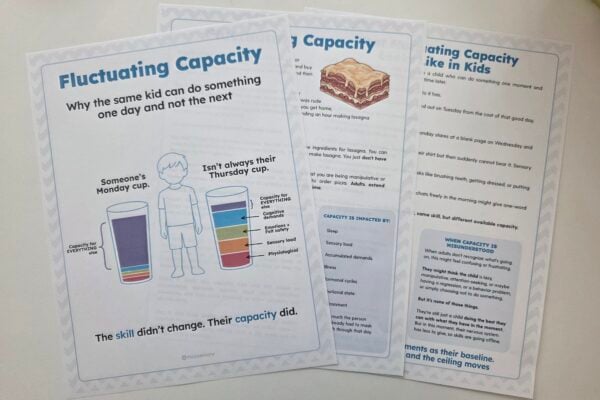
  • "A photo of three printed Think Sensory resource pages fanned out on a white surface. The front page is fully visible and titled 'Fluctuating Capacity: Why the same kid can do something one day and not the next.' It features two illustrated cup diagrams flanking a simple drawing of a child. The left cup, labeled 'Someone's Monday cup,' is mostly filled with a large purple section at the bottom labeled 'Capacity for everything else,' with thin colored layers above it. The right cup, labeled 'Isn't always their Thursday cup,' shows the same cup divided into more layers from bottom to top: Physiological, Sensory load, Emotions and felt safety, Cognitive demands, and Capacity for everything else — with each layer taking up more of the cup, leaving less room at the top. The closing statement reads: 'The skill didn't change. Their capacity did.' The two pages behind are partially visible. The middle page shows a partially visible list under the heading 'Capacity is impacted by,' including sleep, sensory load, accumulated demands, illness, hormonal cycles, emotional state, and environment. The rightmost page is partially visible with a heading referencing 'Fluctuating Capacity in Kids' and a callout box titled 'When Capacity is Misunderstood,' which notes that when adults don't recognize what's going on, they might think the child is lazy, manipulative, attention-seeking, or having a regression, but states it is none of those things — the child is doing the best they can with what they have in the moment."
    Fluctuating Capacity Info Sheet
    FREE
    Download NowLoading Done
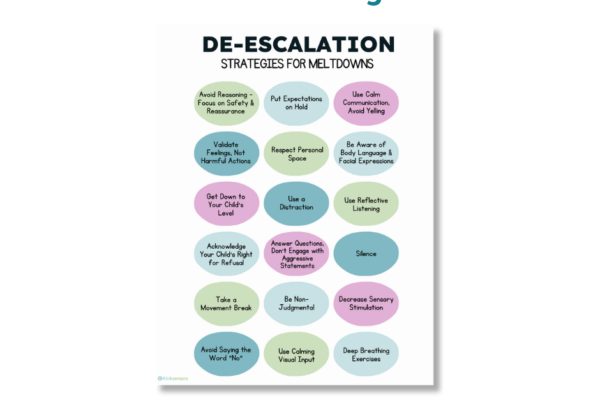
  • "Promotional graphic from Think Sensory showing a poster titled 'De-Escalation Strategies for Meltdowns.' The poster displays 18 strategies arranged in colored oval shapes across six rows: Avoid Reasoning — Focus on Safety and Reassurance; Put Expectations on Hold; Use Calm Communication, Avoid Yelling; Validate Feelings, Not Harmful Actions; Respect Personal Space; Be Aware of Body Language and Facial Expressions; Get Down to Your Child's Level; Use a Distraction; Use Reflective Listening; Acknowledge Your Child's Right for Refusal; Answer Questions, Don't Engage with Aggressive Statements; Silence; Take a Movement Break; Be Non-Judgmental; Decrease Sensory Stimulation; Avoid Saying the Word 'No'; Use Calming Visual Input; and Deep Breathing Exercises."
    De-Escalation Strategies Poster
    FREE
    Download NowLoading Done

  • "Promotional graphic from Think Sensory showing a resource page titled '7-Minute HIIT Workout for Kids.' The page instructs users to set an interval timer and complete each animal movement for 45 seconds, with 15 seconds of rest in between, doing as many as possible. Seven exercises are listed, each paired with a cartoon animal illustration: Frog Jumps — hop back and forth like a frog; Bear Walk — hands and feet on the floor, hips high, walk left and right; Gorilla Shuffle — sink into a low sumo squat with hands on the floor and shuffle around the room; Starfish Jumps — jumping jacks as fast as possible with arms and legs spread wide; Cheetah Run — run in place as fast as possible, like the fastest animal in the Sahara; Crab Crawl — sit with palms flat on the floor behind the hips, lift up off the ground, and crawl; Elephant Stomps — march in place lifting knees as high as possible and stomping the ground as hard as possible."
    7-Minute HIIT Workout for Kids
    FREE
    Download NowLoading Done

© 2026 Think Sensory     |     Privacy Policy     |      About     |     Terms of Service

Scroll to top
  • Learn
    • Continuing Education
    • Sensory Journey Summit
    • Research Summaries
  • Explore
    • Articles
    • Videos
    • Activities
  • Connect
  • Printables
  • Learn
    • Continuing Education
    • Sensory Journey Summit
    • Research Summaries
  • Explore
    • Articles
    • Videos
    • Activities
  • Connect
  • Printables