

What’s inside this article: An in-depth look at what Pathological Demand Avoidance is, its characteristics, common demand avoidance techniques, and how PDA manifests in children. This article includes advice for both parents and educators, and how to seek professional support.
The term Pathological Demand Avoidance was first used by developmental psychologist Elizabeth Newson in the 1980s. She proposed that pathological demand avoidance, or PDA for short, was a “distinct behavioral profile” seen in some autistic children.
She proposed the term to describe children who did not want to cooperate with instructions, even when doing so would be in their own interest. She had identified a group of children who had this characteristic and would avoid everyday demands and expectations to an extreme extent.
Her observations looked different from what was typically seen in other autism presentations at the time.
PDA is now widely recognized as a behavioral profile within autism. The PDA Society and the National Autistic Society both acknowledge PDA and it’s gaining more recognition among medical professionals.
However, it’s important to know that PDA is not currently listed as a separate diagnosis in the DSM-5 or ICD-11. During an autism assessment, a clinician may identify that a person has a PDA profile, which may then inform their support plan.
You may also hear PDA referred to as Persistent Drive for Autonomy. Many in the neurodiversity community prefer this framing, as do we, because it centers the person’s need for autonomy rather than pathologizing the avoidance itself. However, we’re using “Pathological Demand Avoidance” throughout this article for search engine visibility because that’s still the term most people are typing into search engines, and we want this information to actually reach the people who need it.
This article offers an in-depth explanation of PDA for parents and educators so you can better understand its characteristics, how it shows up in children, and what steps to take if you think your child may have a PDA profile.
What Is Pathological Demand Avoidance (PDA)?
Pathological Demand Avoidance (PDA) is a behavioral profile within autism. People with a PDA profile experience extreme avoidance of everyday demands and requests. This avoidance includes activities that are routine or even enjoyable for them.
People with PDA may use a variety of avoidance strategies. They often go to great lengths to avoid demands, and when avoidance strategies don’t work, the result can be intense stress, meltdowns, or shutdowns. This is described in more detail below.
Current Understanding of PDA
Professionals in psychology and pediatrics view PDA as a complex behavioral profile that can vary significantly from one person to another.
PDA is still a subject of ongoing research and debate. Some experts see it as a distinct profile within autism, while others view it as part of broader autism-related behaviors.
Current research is focused on understanding the unique challenges people with PDA face and how to support them better.
A 2026 study published in Research in Autism (University of Hertfordshire) looked at 795 children aged 4-17, grouped into three categories: autistic children with a PDA profile (475), autistic children without a PDA profile (171), and neurotypical children (94). Parents completed questionnaires assessing demand-avoidance traits, autism traits, anxiety, intolerance of uncertainty (not knowing what to expect, not knowing how long something will take, etc.), and sensory-processing patterns.
The findings were significant:
- Across all three groups, higher levels of anxiety and autism traits corresponded to more demand avoidance. That was consistent regardless of group.
- For autistic children with a PDA profile, sensory reactivity (particularly tactile sensitivity and sensory seeking, but not only these things) was a unique predictor of demand avoidance, even after accounting for anxiety and autism traits. That means the sensory experience these children are having appears to be a significant factor in why they avoid certain demands.
- For neurotypical children, intolerance of uncertainty was what predicted demand avoidance.
- For autistic children without a PDA profile, neither sensory reactivity nor intolerance of uncertainty added anything beyond anxiety and autism traits alone.
This matters because it reframes demand avoidance as something that can make a lot of sense from the child’s perspective. When an autistic child with a PDA profile is avoiding a demand, their sensory environment may be playing a much bigger role than most people realize.
A child pulling away from a task may be communicating something important about what their nervous system is experiencing in that moment.
The researchers suggest that support for these kids should take environmental sensory demands into account – what does the space feel like, what textures or sensations are involved, how much sensory input is happening at once – rather than focusing only on the avoidance behavior. Which, to be fair, is something we should be doing for all children anyway.
Experts also believe anxiety plays a central role in PDA, and that developing tailored, low-demand approaches can improve daily life for both children and adults with a PDA profile.
Does PDA Only Occur in Autism?
PDA has historically been understood as a profile within autism, and that’s still the most common framing you’ll see in clinical and research settings. But there is a growing body of evidence suggesting that demand avoidance traits can and do show up outside of autism.
Christopher Gillberg, a professor of child and adolescent psychiatry at the University of Gothenburg, has been one of the most prominent voices on this. In a 2014 commentary published in the Journal of Child Psychology and Psychiatry, he wrote that based on decades of clinical experience, extreme demand avoidance is seen in individuals with ADHD (particularly the inattentive presentation), language disorders, selective mutism, school refusal, anorexia nervosa, epilepsy, and certain genetic conditions.
He suggested that PDA may not be a variant of autism or ODD at all, but could represent its own phenotype with multiple co-occurring conditions, similar to other neurodevelopmental presentations.
A 2015 general population study in the Faroe Islands (Gillberg et al., published in European Child and Adolescent Psychiatry) found that approximately 1 in 5 autistic individuals in the study showed indications of PDA in childhood. The researchers noted that the criteria for PDA were unlikely to be consistently met in later adolescence and early adulthood, though more research is needed on how PDA traits change over time.
One of the more notable findings came from a 2020 study by Egan, Bull, and Trundle, published in Research in Developmental Disabilities. They looked at self-reported PDA traits in a community sample of 126 adults and found that ADHD was a significantly stronger predictor of PDA traits than autism. The correlation between ADHD and PDA was strong (r = 0.71), while the correlation between autism and PDA was small and did not significantly predict PDA scores.
The researchers concluded that for adults in the general population, ADHD, emotional instability, and antagonism appeared to better predict PDA than autism did.
That finding is important, and it’s also important to be careful with it. The study was based on self-report measures in a community sample, not clinical diagnoses. And because ADHD and autism co-occur at high rates (research suggests around 50-70% of autistic individuals also have ADHD), it can be difficult to separate which condition is driving the demand avoidance in any given person. More research is needed to tease those relationships apart.
A 2024 scoping review published in Frontiers in Education summarized the broader picture: several researchers have drawn connections between PDA and conditions beyond autism, including ADHD, ODD, language disorders, and trauma-related presentations. Some researchers have proposed the term “demand avoidance phenomena” to describe demand avoidance that occurs across diagnostic categories, recognizing that people without an autism diagnosis who experience significant demand avoidance also need support and recognition.
The Child Mind Institute has drawn a useful comparison here. They note that PDA traits may be similar to sensory processing differences in this respect: sensory challenges are very common in autistic children and are considered a feature of autism, but they also occur in children with ADHD and in children with no diagnosed developmental condition. PDA traits may work the same way, existing across a broader population with variability in how much a person is affected.
What this means practically is that if your child shows a pattern of extreme demand avoidance but doesn’t have an autism diagnosis, or has ADHD but not autism, that doesn’t automatically rule out a PDA profile.
The research supports the idea that demand avoidance traits exist on a continuum and can show up across neurodevelopmental presentations. The most important thing is to understand what’s driving the avoidance in your specific child and to find professionals who are willing to look at the full picture rather than dismissing the pattern because it doesn’t fit neatly into one diagnostic box.
Characteristics of PDA
Autistic children with a PDA profile share characteristics with other autistic people, including differences in social communication, repetitive behaviors or intense interests, and sensory processing differences.
However, they also experience what is described as “An anxiety-driven need to be in control and avoid the demands and expectations of others.”
This is likely connected to the way demands are registered in the nervous system. For people with a PDA profile, even a simple request can activate a threat response – the demand itself feels overwhelming, regardless of what it is. Rigidity and intolerance for the unexpected are common autistic traits, and PDA is thought to be one of the ways that manifests.
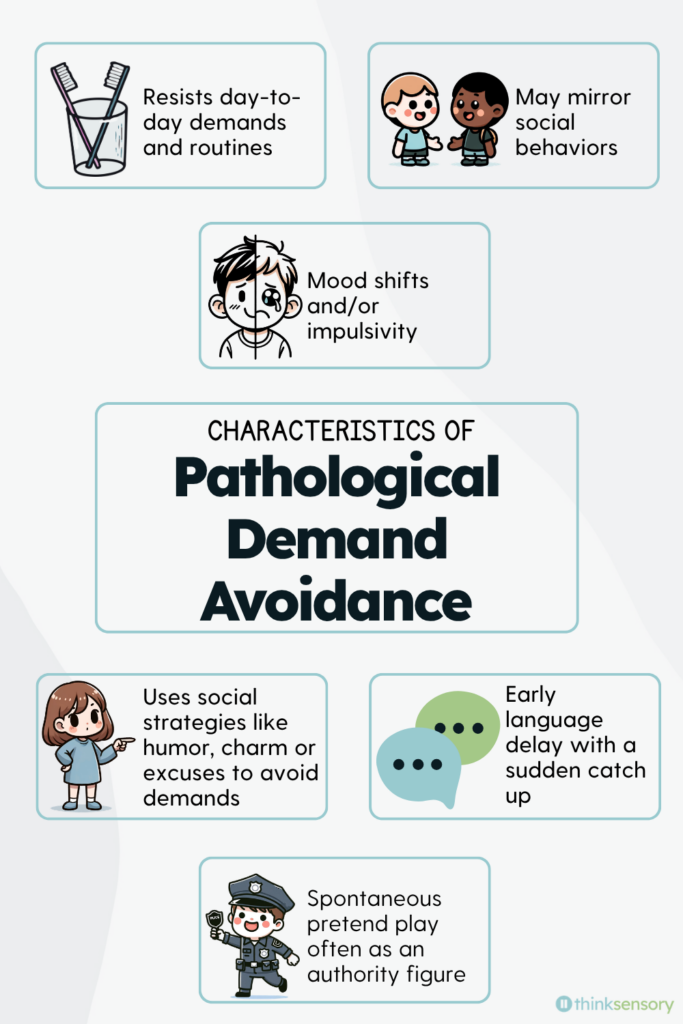
The characteristics of pathological demand avoidance include:
Resists ordinary day-to-day demands and routines
This includes day-to-day activities such as getting dressed, eating meals, family activities, etc. Children with PDA will resist these demands even if it’s something they want to do.
For example, if your family was going to the playground and you told your child, “Put on your shoes, we’re going to the playground,” despite wanting to go, your child would resist or refuse to put on their shoes.
This is where the 2026 research findings become really practical. That resistance might not only be about the demand itself. It could also be about the sensory experience involved – the feeling of shoes on their feet, the texture of socks, the transition from one environment to another. Understanding that helps you support the moment differently.
Appears to be more social than other autistic children
A child with pathological demand avoidance may appear more socially engaged than what people typically expect from an autistic child. They may be drawn to social interaction and seem comfortable with other people on the surface.
However, children with PDA often learn social behaviors by observing and mirroring others, without always having an intuitive grasp of the implicit social rules underneath.
You might notice they can hold a conversation or seem charming, but struggle with the unwritten expectations that most people pick up on automatically.
Intense mood shifts and impulsivity
Kids with PDA may have sudden, intense changes in mood, or they may use impulsive behavior as an avoidance strategy.
These behaviors, which on the surface level may seem like a tantrum or intentional, are most likely a nervous system stress response to feelings of extreme anxiety.
If you ask your child about the impulsive behavior afterward, they may say things like “their brain told them to do it” or that they knew it wasn’t a good choice but couldn’t stop themselves. This may be very upsetting to them as well.
Engages in pretend play
Autistic children are often described as not engaging in pretend play in the way developmental milestones expect. When they do, it may look like recreating scenes from shows or repeating the same scenario, which is still imaginative play – it just looks different from what’s typically expected.
However, children with PDA engage in more spontaneous pretend play and may often take on the role of an authority figure—for example, pretending to be a police officer, teacher, etc.
Kids with pathological demand avoidance may also use their pretend play as a way to avoid demands.
Social strategies that look like manipulation
It may seem like children with pathological demand avoidance are manipulative or always know just what to do or say to get out of something or push your buttons.
They may use strategies like lying, blame-shifting, charm, humor, or opposition to escape demands.
These behaviors are coping mechanisms. They’re strategies the child has learned (often unconsciously) to manage the anxiety and stress caused by demands or expectations. Understanding this is important for parents and educators so they can respond with support rather than punishment.
Early language development:
Although kids with a PDA profile may have an early language delay, similar to other autistic children, typically they “catch up” to their peers more suddenly, as opposed to a more gradual progression or a plateau.
Internalizing PDA vs. Externalizing PDA
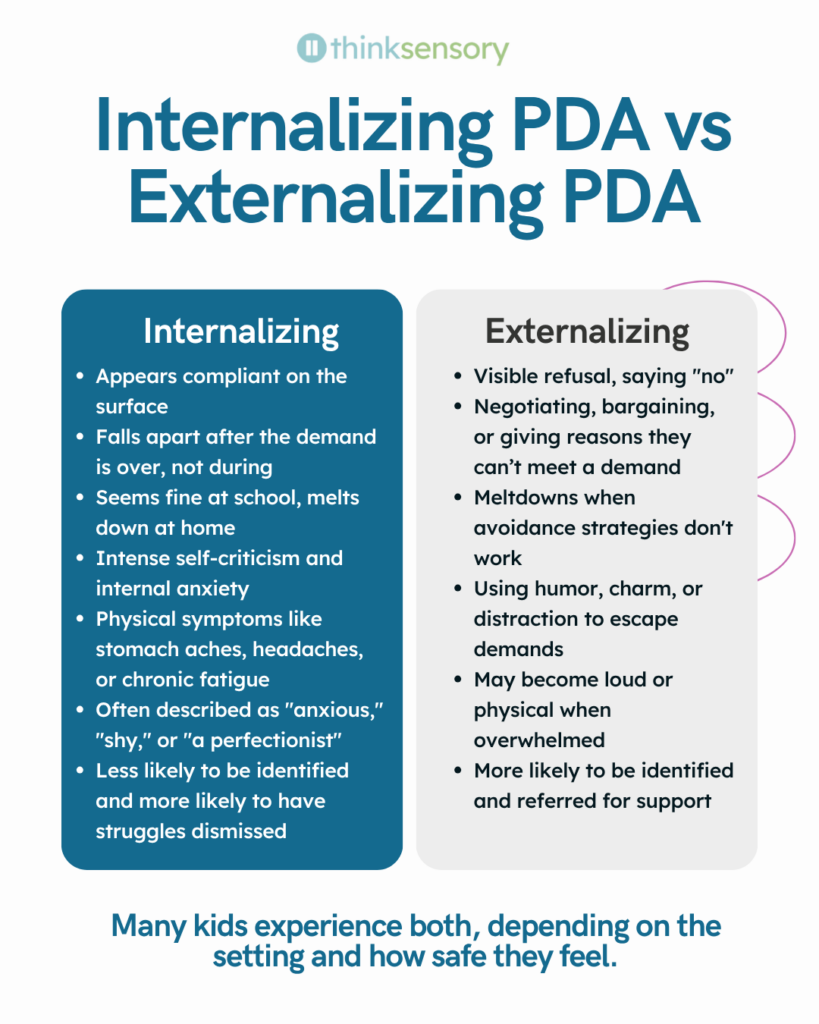
Most descriptions of PDA focus on the externalizing presentation – the visible refusal, the negotiation, the meltdowns. That’s what tends to get noticed by parents, teachers, and clinicians because it’s hard to miss.
But PDA can also be internalized. A child with internalizing PDA may appear compliant on the surface while experiencing intense anxiety, self-criticism, and overwhelm underneath. Instead of refusing outwardly, they turn the distress inward.
Where externalizing PDA might look like “I won’t do it and you can’t make me,” internalizing PDA often looks more like a child who does the thing but falls apart afterward, or a child who seems fine at school and then melts down the moment they get home.
They might experience burnout and develop physical symptoms like stomach aches, headaches, or chronic fatigue from the constant effort of pushing through demands that feel threatening to their nervous system.
Internalizing PDA is harder to spot, which means these kids are less likely to be identified and more likely to have their struggles dismissed. They may be described as “anxious” or “shy” or “a perfectionist” without anyone connecting that back to demand avoidance.
Many people experience both – they may internalize at school where they don’t feel safe enough to push back, and externalize at home where they do. The presentation can also shift depending on stress levels, the environment, and the specific demands they’re facing.
How PDA Characteristics Show Up in Different Settings
Pathological demand avoidance affects all areas of a person’s life.
In home settings, PDA might show up as resistance to family routines or refusal to do household tasks and chores.
In school settings, the structured nature of the day can feel overwhelming. This often leads to avoidance of classroom activities, social expectations, and homework.
In social settings, group dynamics, following social norms, and organized sports or group activities are often really challenging. They may struggle to form and maintain friendships and find it hard to build positive relationships with authority figures.
Across all of these settings, it’s worth paying attention to the sensory environment. Based on recent research, the sensory demands of a space – noise levels, lighting, textures, physical proximity to others – may be contributing to avoidance in ways that aren’t immediately obvious.
Co-Occurring Conditions
PDA doesn’t usually show up by itself. Many kids with a PDA profile also have other co-occurring conditions that affect how they experience the world and how their avoidance presents.
Some of the most common co-occurring conditions include:
ADHD: Many children with a PDA profile also have ADHD. The executive functioning challenges that come with ADHD (difficulty starting tasks, trouble with transitions, working memory differences) can layer on top of demand avoidance and make everyday expectations feel even more overwhelming. A child who already experiences demands as threatening AND struggles with task initiation is facing a double barrier.
Anxiety disorders: While anxiety is considered central to PDA itself, some children also meet the criteria for a separate anxiety disorder. Generalized anxiety, social anxiety, and separation anxiety are all common. These can amplify demand avoidance because the child is managing a higher baseline of stress before any demand is even placed on them.
OCD traits: Some children with PDA show obsessive-compulsive traits or meet the criteria for OCD. This can sometimes be hard to distinguish from PDA-related rigidity. If a child needs things done in a very specific way and becomes extremely distressed when that doesn’t happen, it’s worth exploring whether OCD is part of the picture.
Depression: Particularly in older children and adolescents, the chronic stress of navigating a world full of demands that feel threatening can contribute to depression. This is especially true for children with an internalizing PDA presentation who push through demands at school and collapse at home.
Sensory processing differences: While sensory reactivity is part of the PDA profile itself some children also have more extensive sensory processing challenges that warrant their own attention in a support plan.
Understanding co-occurring conditions matters because they affect what kind of support will actually help.
A child whose demand avoidance is being amplified by untreated ADHD or anxiety may respond differently to strategies than a child whose PDA profile is the primary factor. Comprehensive assessment that looks at the full picture gives families and professionals more to work with.
PDA vs. Oppositional Defiant Disorder (ODD)
One of the most common labels parents run into before PDA is identified is Oppositional Defiant Disorder. ODD is a DSM-5 diagnosis defined by a pattern of “angry or irritable mood, argumentative or defiant behavior, and vindictiveness.” It’s one of the most frequently diagnosed behavioral conditions in childhood.
It’s important for parents to understand that ODD as a diagnosis is facing growing scrutiny within the clinical community.
A 2025 paper published in Pediatrics (the journal of the American Academy of Pediatrics) by child psychiatrist Dr. Rupinder Legha argues that ODD, by design, locates the problem in the child rather than looking at what’s driving the behavior, whether that’s neurodevelopmental differences, trauma, or environmental mismatch.
The diagnosis also carries significant racial bias. Research has found that ODD diagnoses are 35% more prevalent in Black children than in white children, a disparity that reflects racialized perceptions of defiance rather than actual behavioral differences.
Many clinicians are now reframing the behaviors associated with ODD as adaptive responses to the child’s environment, attachment disruptions, sensory overwhelm, or unidentified neurodivergence, rather than as a fixed feature of the child.
This is an important shift, and it’s one that aligns with what we know about PDA.
If you’re a parent exploring PDA vs ODD keep in mind
The behaviors can look similar on the surface, but what’s underneath is different. A child with a PDA profile avoids demands of all kinds, including things they want to do, things that are fun, and even self-imposed expectations. The avoidance is driven by anxiety and a nervous system that registers demands as threats. It’s broader than resistance to authority. If your child is avoiding demands across the board and not just pushing back on rules or specific people, that pattern is worth paying attention to.
ODD has a high co-occurrence with ADHD and autism. A 2025 study published in the Journal of Autism and Developmental Disorders (Mayes et al.) found that 53% of children with ADHD-Combined presentation met criteria for ODD, and that number rose to 62% when autism co-occurred with ADHD.
The researchers noted that the high co-occurrence of ADHD in autism largely explains the high prevalence of ODD in autistic children. In other words, what gets labeled as ODD may actually be a feature of how autism and ADHD present together, not a separate condition.
Compliance-based strategies tend to make things worse for kids with PDA. Reward charts, consequences, firm boundaries, and structured behavioral approaches are commonly recommended for ODD.
For a child whose avoidance is anxiety-driven, these approaches typically escalate distress rather than reduce it. If your child has been given an ODD diagnosis and the recommended strategies aren’t working or are making things harder, that’s worth flagging with their provider.
Social presentation can complicate the picture. Children with PDA do often appear more socially skilled than what people typically expect from autistic children. They may use charm, humor, and social strategies as part of their avoidance. This can make it harder for professionals to recognize the autism underneath, which contributes to misidentification.
If your child has been diagnosed with ODD but the label doesn’t feel like it captures what you’re seeing, or if the strategies aren’t working, it’s worth exploring whether a PDA profile is a better fit. Look for a professional who is familiar with PDA specifically, because many clinicians are not yet trained to recognize it.
Insights from Professionals:
Child psychologists emphasize the importance of understanding the underlying anxiety that drives PDA behaviors.
Identifying PDA involves looking beyond the surface behaviors to understand the child’s need for control and comfort in response to anxiety.
Observing the child in various settings and consulting with professionals who can offer a comprehensive assessment and guidance for support and intervention strategies is recommended.
Avoidance Strategies Used by Kids with Pathological Demand Avoidance (PDA)
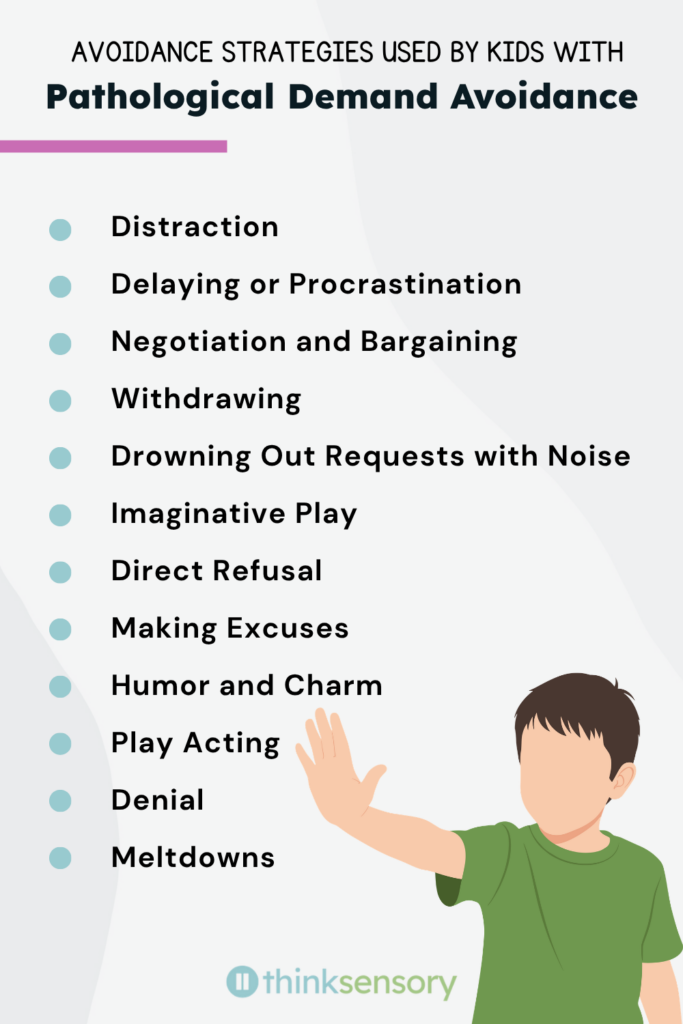
Children with pathological demand avoidance will use various avoidance techniques to avoid demands. Understanding what these techniques look like can help parents and educators respond more effectively and develop strategies to support children with PDA.
- Distraction: Asking questions, changing the subject, or engaging in behaviors that divert attention away from the demand.
- Delaying or Procrastination: Delaying the response to a demand, definitely or indefinitely. For example, they may say, “I’ll do it in 10 minutes?” or “I’ll get to it soon.”
- Negotiation and Bargaining: Trying to alter the terms of the demand to make it more acceptable. For example, “Can I put away half of my laundry now and the other half after my favorite show?”
- Withdrawing: This includes covering their face, acting like they don’t see or hear you, or physical withdrawal, like leaving the situation or hiding.
- Drowning out requests with noise: For example, singing loudly, yelling, screaming, and even swearing over you when you speak.
- Imaginative play to avoid demands. For example, they may say, “I can’t put my shoes on, I’m a cat, and cats don’t wear shoes,” then begin crawling on the floor and meowing.
- Direct Refusal: Simply saying ‘no’ or not responding to requests.
- Making Excuses: Providing reasons, which could be genuine or fabricated, to avoid complying with a demand.
- Humor or Charm: Using humor or being overly charming to deflect from the demand.
- Play Acting: Pretending not to understand or role-playing as someone else.
- Denial: Claiming you never asked them to do something to begin with or suggesting the demand isn’t relevant to them.
- Meltdowns: When other avoidance strategies don’t work, the child’s distress may escalate to a full meltdown. This overwhelming emotional response isn’t a choice, but it does make it impossible for them to comply with any demand.
Challenges of PDA in School
School-age children with PDA face unique challenges in educational environments, such as:
- Difficulty with Routine and Structure: The structured nature of school can be overwhelming.
- Resistance to Classroom Demands: Tasks like completing assignments or participating in group activities can trigger avoidance.
- Social interaction challenges: Despite often appearing more socially engaged, children with PDA may struggle with the complex social dynamics of school.
- Sensory demands of the classroom – Based on recent research, the sensory environment of the classroom (noise, lighting, textures of materials, physical proximity to other students) may be contributing to demand avoidance in ways that aren’t immediately visible.
Teachers and educators can support children with PDA by:
- Learn about PDA – Understanding how PDA impacts learning and behavior in the classroom makes a huge difference.
- Collaborative Approach: Working closely with parents and specialists to develop effective strategies.
- Focus on connection over compliance – Build a relationship with the child that feels safe. When a child trusts you, the perceived threat of demands goes down.
- Emotional Support: Recognizing and addressing the child’s emotional needs, helping them feel safe and understood in the school environment.
- Modify language to reduce perceived demands – Change the way tasks and instructions are given so the child feels more in control and has more choices.
- Differentiation in the Classroom: Adapting teaching methods to accommodate the child’s need for control and comfort.
- Consider sensory needs – Pay attention to the sensory demands of the environment and reduce them where possible. The research supports this as a meaningful intervention.
- Individualized Learning Plans: Tailoring educational plans to the child’s specific strengths and challenges.
Parenting Strategies for PDA Children
When parenting a child with PDA, understanding that their avoidance behavior is driven by anxiety – not a conscious decision to make things harder – is the most important starting point.
Every child with PDA is unique, so tailoring your approach to your child’s individual needs and challenges is essential.
At its core, parenting strategies for kids with PDA involve building a collaborative relationship with your child. It’s better to focus on long-term coping abilities rather than short-term compliance.
You’ll want to reduce the perception of demands while supporting your child’s social-emotional development and sensory needs.
Given what the research tells us about sensory reactivity and PDA, it’s also worth looking at the sensory demands involved in everyday routines. If your child consistently avoids a particular task, consider what the sensory experience of that task might feel like for them.
Sometimes small changes to the environment or materials can make a big difference.
For more in-depth information, read this list of 15 effective parenting strategies for children with pathological demand avoidance.
Seeking Support and Professional Help
If you’re noticing consistent patterns of demand avoidance in your child that are impacting their daily life, you should consider seeking professional support.
It’s worth knowing upfront that many professionals are not yet familiar with PDA. It is not a separate diagnosis in the DSM-5 or ICD-11, and many clinicians have had limited or no training on PDA specifically. This means you may need to advocate for your child during the assessment process, and you may need to seek out professionals who have specific experience with PDA rather than relying on a general referral.
If a professional dismisses your concerns or suggests that your child is “just being defiant,” that’s a sign to keep looking. A clinician who understands PDA will recognize that the avoidance is anxiety-driven and will not recommend compliance-based strategies as the primary approach.
It can also be helpful to bring information with you to appointments. Documenting patterns you’re seeing at home and at school, including what triggers avoidance, what strategies your child uses, and what happens when demands are pushed, gives a professional something concrete to work with, especially if they’re less familiar with the PDA profile.
How to Seek Help for Pathological Demand Avoidance:
- Consult your pediatrician – Start with your child’s primary healthcare provider to discuss concerns and get referrals.
- Specialist evaluation – Seek assessment from a child psychologist or psychiatrist, especially those with experience in autism and PDA.
- Look for professionals who take a neurodiversity-affirming approach – this matters because compliance-based strategies tend to make things worse for kids with PDA, not better.
- Ask specifically about PDA experience – When contacting a professional, ask whether they are familiar with PDA and how they approach demand avoidance in neurodivergent children. Their answer will tell you a lot about whether they’re the right fit.
- Educational assessment – Involving school psychologists or educational specialists can provide insights into how PDA affects learning and help the school develop an individualized education plan.
- Comprehensive approach – Often, a multi-disciplinary approach involving different professionals is the best way to support your child.
Key Takeaways
Understanding PDA means looking beyond the avoidance behavior to what’s driving it – anxiety, sensory processing, and a nervous system that perceives demands as threats.
Recent research confirms that for autistic children with a PDA profile, sensory reactivity plays a significant role in demand avoidance. That gives parents and professionals something concrete to work with: instead of focusing only on changing the child’s behavior, we can also change what the environment is asking of their body.
Build a collaborative relationship with your child. Seek out professionals who understand PDA and take a neurodiversity-affirming approach. Focus on long-term coping abilities rather than short-term compliance.
Every child with a PDA profile is unique, and what works will look different for every family.
Additional Reading:
- Article: 15 Effective Parenting Strategies for PDA
- Article: 18 De-Escalation Techniques
- Free printable: PDA Information Booklet
