
From the outside, emotional dysregulation can look like a huge reaction to something seemingly small (to the adult). Maybe it’s tears over the wrong color socks, a meltdown in the grocery store, or a kid who “goes from zero to one hundred” in three seconds.
But what’s actually happening underneath is important. Dysregulation is when a kid’s internal state (their energy, emotions, or sensory input) is out of sync with what the moment is asking of them, and they do not yet have the skills or capacity to shift it on their own.
Disclaimer: This post contains affiliate links.
Regulation Does Not Mean Calm, Quiet, and Compliant
Regulation isn’t about a child sitting still and silent, or even about them playing calmly. Regulation means their energy and state match what the task or environment needs/expects.
So a kid who’s screaming with joy on the swings is regulated. A kid focused and quiet during a movie is regulated. A kid bouncing and loud at recess is regulated A kid using a fidget at their desk during silent reading, moving but still reading, is regulated.
Kids Are the Experts on What Works for Them
Everyone is different, which means different tools and strategies will be effective at helping different children regulate. The strategies that actually work are usually the ones kids choose themselves.
If a kid’s body needs a snack and ten minutes on the swings, forcing them to sit and do breathing exercises won’t help. In fact, it’ll probably make things harder.
Use these lists as a menu of ideas to explore together. Not a prescription. This is basically a massive brain storm of possible regulation strategies.
Let kids try things, notice what helps, and build their own toolkit over time.
Emotional Self-Regulation and Dysregulation
When kids are dysregulated, what adults often label as “behavior” is usually the nervous system asking for help. Kids are doing the best they can with the capacity they have in that moment.
Sometimes they have not learned a regulation skill yet. Sometimes they have the skill but cannot access it right now because they are tired, hungry, overwhelmed, or sick. Capacity varies from day to day and moment to moment.
A lot of the time, kids also cannot name what they are feeling. It is hard to cope with something you cannot label or understand.
The good news is that regulation skills can be learned and practiced together, a little at a time. This post has a big list of ideas to try.
Types of Emotional Regulation
There are two types of emotional regulation: co-regulation and self-regulation. Both matter, and both stay part of human life forever.
Co-Regulation
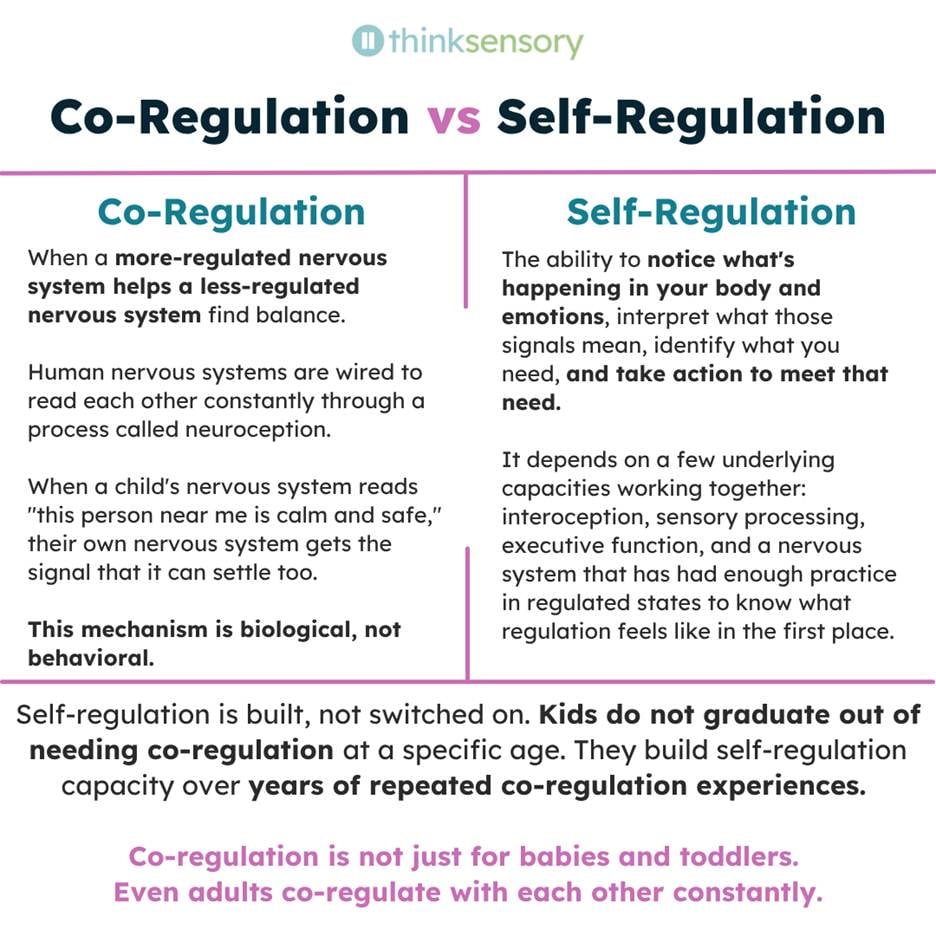
Co-regulation is when a more-regulated nervous system helps a less-regulated nervous system find balance. With kids, it usually means a calm, attuned adult using their own regulated state to bring a child back into a regulated state.
The adult’s body and presence does most of the work, through cues like tone of voice, facial expression, breathing rhythm, pace of movement, proximity, predictability, and sometimes touch.
The mechanism is biological, not behavioral.
Human nervous systems are wired to read each other constantly through a process called neuroception (a term from polyvagal theory). When a child’s nervous system reads “this person near me is calm and safe,” their own nervous system gets the signal that it can settle too.
That’s why telling a dysregulated child to “calm down” rarely works, but a slow exhale, a soft voice, and a steady body next to them often does.
Co-regulation is not just for babies and toddlers. Adults co-regulate with each other constantly. Anyone whose nervous system is in a stress response can benefit from being near a regulated nervous system, regardless of age. The research is clear that co-regulation stays a healthy part of human life across the entire lifespan.
Self-Regulation
Self-regulation is the ability to notice what’s happening in your body and emotions, interpret what those signals mean, identify what you need, and take action to meet that need. It is not the same as “being calm” or “behaving well.” A regulated state can be calm, alert, energized, focused, or sleepy depending on what the situation calls for. The skill is matching your internal state to what you actually need, and being able to shift it when needed.
It depends on a few underlying capacities working together: interoception (sensing internal body signals), emotional vocabulary, sensory processing, executive function, and a nervous system that has had enough practice in regulated states to know what regulation feels like in the first place.
How Kids Move from Co-Regulation to Self-Regulation
Self-regulation is built, not switched on. Kids do not graduate out of needing co-regulation at a specific age. They build self-regulation capacity over years of repeated co-regulation experiences.
Each time a caregiver helps a child move from dysregulated back to regulated, the child’s brain is laying down the neural pathways that will eventually let them do that for themselves. Self-regulation is essentially internalized co-regulation.
A few things shape how this builds:
- The prefrontal cortex, which is heavily involved in regulation, is not fully mature until the mid-twenties. So, expecting consistent self-regulation from a 6-year-old, or a 12-year-old, or even a 19-year-old is asking the brain to do something it is not yet developmentally ready to do reliably.
- The progression is not linear. Even kids who can self-regulate in low-demand situations will need more co-regulation when they are tired, hungry, sick, sensory-overloaded, or stressed. This is true for adults too. Capacity moves up and down depending on context.
- Neurodivergent kids often need more co-regulation for longer, and that is not a deficit. It can reflect a nervous system that is processing more sensory information, has a different threshold for stress, or has had fewer experiences of attuned co-regulation if their cues were missed or misread. The work is not pushing them toward independence faster. It is providing reliable co-regulation so the underlying capacity can build.
The shift from co-reg to self-reg happens gradually as kids start to recognize their own internal signals, name what they are feeling, identify what their body needs, and try strategies on their own.
They often try and fail many times before the right strategy lands successfully and can be used independently. But the trial-and-error of practicing with different tools is part of the skill-building process.
Some Things to Remember
- Felt safety always comes first: A kid whose nervous system does not feel safe usually cannot regulate, no matter how good the strategy. Connection, predictability, and a calm adult presence come before any tool on this list.
- Sensory Input IS regulation: For many kids, especially autistic and ADHD kids, sensory input is not a distraction from regulating. It is the regulation. Stimming, movement, deep pressure, and rhythmic input are regulation tools.
- When nothing works: During a full meltdown, running through strategies usually makes things harder. The move is to stay present, reduce demands, lower stimulation, and wait for the nervous system to settle. These lists are best used for teaching and prevention, not rescue mid-meltdown.
Choosing Emotional Regulation Strategies that Work
A regulation strategy is only useful if your child can access it in the moments they actually need it. The most clinically sound tool in the world is useless if it does not fit the child, the family, or the daily reality of when dysregulation shows up.
Before picking strategies to try, it helps to have a rough sense of where your child currently sits on the regulation development trajectory. That tells you what kind of support to lean on most heavily right now: co-regulation, scaffolded self-regulation with adult support nearby, or independent strategies your child is starting to use on their own. It also tells you what is realistic to expect from them in the moment.
From there, a few things to consider when choosing what to try.
1. Is it developmentally appropriate?
Choose strategies that match your child’s current capacity, not what you think they “should” be able to do. Capacity is not the same as age, and it is not the same as cognitive ability either. Two kids with the same diagnosis, the same age, or the same IQ can have very different regulation profiles, and the same kid can have different capacity on different days.
What matters is what their nervous system can actually deliver in this moment, in this context. That is what the strategy needs to match. When a strategy asks for more than the nervous system can do right now, it will fail, and the failure often gets misread as the child being defiant, manipulative, or unmotivated, when in reality the demand was just too high for their current capacity.
2. Is it functional in real life?
A strategy has to be possible in the spaces and time slots your child actually has. A tool that works beautifully in a quiet therapy room may not be realistic during a busy morning at home, in the middle of a classroom, or in the produce aisle.
The honest test is whether it can show up in the moments your child actually struggles. Ask yourself where most of the dysregulation happens, what is realistically available in those moments, and whether the strategy fits inside that window.
If it requires more time, equipment, privacy, or adult support than the situation allows, it will not get used reliably, no matter how well it works on paper.
This is also where formal supports can do a lot of heavy lifting. A regulation strategy that works well but needs 10 minutes of decompression time, access to a quiet space, or movement breaks can absolutely be built into the school day through accommodations on a 504 plan or IEP.
If the strategy your child needs is not possible in their current school setup, the answer is not always to pick a different strategy, sometimes the answer is to adjust the environment and allow accommodations and supports that make the right strategy possible.
Function also means thinking creatively about how a tool moves through your child’s day. A weighted lap pad does not have to stay at home. Noise-canceling headphones can live in a backpack. The question is not just “does this tool work” but “how does this tool actually fit into our life, our schedule, and the places we go.”
When a strategy is the right fit functionally, it gets used.
3. Does it match the sensory preferences?
Sensory input is one of the most powerful regulation tools available, but the same input can regulate one child and dysregulate another. Deep pressure can be calming for a sensory seeker and overwhelming for someone who is hyper-responsive to touch. Loud rhythmic music can help one child focus and send another into overload.
Knowing your child’s sensory preferences, what kinds of input they seek and what they avoid, is essential before trying any sensory-based strategy.
4. Do you have the child’s buy in?
A tool the child rejects, finds embarrassing, or does not trust is not going to work, regardless of how appropriate it appears to fit clinically. Choosing strategies WITH kids has much better odds than choosing FOR them. Their own preferences are useful data too.
What they reach for naturally often tells you what their nervous system is already asking for.
This is also where emotional regulation and self-advocacy start to overlap. A child who learns to notice what helps them, ask for it, and adjust as needed is building both skills at the same time.
5. Does it align with family priorities and values?
For clinicians and educators, especially, the strategies you teach a child will only stick if they are consistent with what is happening at home. Parents, teachers, and therapists need to be working as a team, with open communication and shared language. A strategy that gets praised in therapy and dismissed at home (or vice versa) creates confusion for the child and undermines the work everyone is trying to do.
6. Patterns and rhythms
Sometimes the most effective regulation work happens upstream of the dysregulation moment, not inside it. Sleep, hunger, screen use, time of day, hormones (for older kids), medication timing, and the weekly rhythm of demands all affect baseline capacity.
A child who melts down every single Wednesday afternoon may benefit more from a schedule change, an earlier dinner, or a quieter morning than from a new in-the-moment strategy.
Looking at the patterns over several weeks can tell you whether the issue is a missing skill or a capacity problem caused by something external.
7. Special Contexts
Most kids regulate differently depending on the context, and noticing those patterns is part of choosing the right tool for the right moment.
These are in no particular order, but are here to make you think about how your child’s regulation is affected by different scenarios.
How is your child affected by the following:
- Group sizes? Large or small
- New environment vs. familiar environment?
- Familiar caregiver vs. unfamiliar caregiver?
- When feeling sick or tired?
- When feeling hungry?
- How do they handle transitions, especially being pulled out of a fun activity for something less preferred (sitting down for a snack, leaving the playground, switching off screens)?
Knowing your child’s pattern across these contexts means you can match the strategy to the moment, and you can plan ahead for the situations where you already know capacity is going to be lower.
Co-Regulation Strategies (What Adults Do)
Your body and presence
- Sit on the floor next to them
- Get below their eye level
- Open your body language, uncross your arms
- Soften your facial expression
- Drop your own shoulders before approaching them
- Slow your movements down
- Slow your breathing audibly so they can hear and match it
- Put your phone down and turn toward them
- Sit shoulder-to-shoulder instead of face-to-face
- Match their pace before trying to shift it
- Place a steady hand on their back, with consent
- Take your own deep breath first
Your voice
- Lower your voice to almost a whisper
- Slow your speech down
- Use fewer words
- Stop talking entirely
- Stop asking questions
- Avoid sarcasm
Words to avoid
- Stop saying “calm down”
- Stop saying “you’re fine”
- Stop saying “use your words” mid-meltdown
- Stop comparing them to siblings or other kids
Validating language
- Say “It makes sense that you feel this way”
- Say “That sounds really hard”
- Say “I’m here, I’ve got you”
- Say “You don’t have to talk about it right now”
- Say “You’re safe”
- Verbalize what you see in their body (“I can see your fists are tight”)
- Reflect their feeling back without trying to shift it
- Apologize when you misread the moment
Reduce the sensory load
- Dim the lights
- Turn off overhead lights, switch to a lamp
- Lower the volume of music or TV
- Turn off the TV completely
- Move to a quieter room
- Move to a less crowded space
- Step outside for fresh air
- Close the door
- Pull the curtains
- Open a window if they’re overheated
Reduce the cognitive load
- Drop one demand
- Cancel the next thing on the schedule
- Skip the errand
- Stop giving instructions
- Reduce the number of choices you offer
- Remove the audience (siblings, other adults watching)
- Stop trying to teach a lesson in the moment
- Stop reasoning or explaining the rule
Predictability and preview
- Preview what’s coming next (“In a few minutes we’re going to head to the car”)
- Give a 10-minute, 5-minute, 2-minute warning before transitions
- Use a visual schedule
- Use a visual timer
- Build a consistent morning routine
- Build a consistent bedtime routine
- Have a safe word or a signal that means “I need help”
Connection without pressure
- Make eye contact only if they want it
- Stop forcing eye contact
- Stop redirecting their stims
- Offer a hug, accept a no
- Offer to hold their hand
- Wrap them in a blanket
- Sit back to back
- Lay down next to them
- Just be in the same room without pressure
- Talk about their special interest if they want to
- Ask them to teach you something they’re good at
Body-based co-regulation
- Rock them slowly
- Walk with them at their pace
- Pace the hallway together
- Bounce them gently on a yoga ball
- Squish them with an exercise ball, with consent
- Wrap them in a weighted blanket
- Bear hug them, with consent
- Slow firm pressure strokes down arms or back, with consent
- Massage their hands or feet
Sensory tools to offer
- Offer a weighted lap pad
- Offer noise-canceling headphones
- Offer a fidget toy
- Offer a chewy
- Offer a stress ball
- Offer a sensory bin
- Offer a crunchy snack
- Offer a chewy snack
- Offer a cold drink with a straw
- Offer something warm to hold (heated rice sock, mug)
- Use these sensory diet cards together
- Use the feelings check-in sheet (when they’re regulated enough to use it)
- Use these fun brain break cards
- Play these mindfulness games together
After the moment
- Reconnect when the nervous system has settled
- Reduce demands for the rest of the day, plan recovery time, not punishment
Self-Regulation Strategies (What Kids Try)
Breath
- Take a slow deep breath in through your nose
- Slow your exhale out through your mouth
- Try a balloon breath, fill your belly like a balloon
- Blow out imaginary birthday candles
- Blow bubbles
- Blow on a pinwheel
- Blow pom-poms across a table with a straw
- Hum on the exhale
- Sigh out loud and long
- Yawn on purpose
Big body movement
- Stim freely without trying to hide it
- Press your palms together hard
- Push hard against a wall
- Press your back into a wall and hold it
- Carry something heavy from one room to another
- Push a laundry basket across the floor
- Do wall pushups
- Hang from a pull-up bar or doorway bar
- Climb something safe
- Spin in a swivel chair
- Roll back and forth on the floor
- Do animal walks (bear crawl, crab walk, frog jumps)
- Stomp your feet hard
- Punch a pillow or a punching bag
- Jump on a trampoline
- Bounce on a yoga ball
- Use a sensory swing
- Hang upside down off the couch
- Stretch big and slow
- Shake out your hands and arms
- Run as fast as you can
- Do a movement break – see: 15 fun workouts for kids
Mouth, jaw, and oral input
- Eat something crunchy (apples, carrots, pretzels)
- Eat something chewy (jerky, dried fruit, gummies)
- Eat a popsicle or something cold
- Suck a thick smoothie through a straw
- Drink water through a straw
- Sip something warm
- Chew gum
- Use a chewy necklace or chew tube
- Hum at a low pitch
- Sing your favorite song
Tactile
- Squeeze a stress ball as hard as you can
- Squeeze putty
- Squish kinetic sand
- Stretch slime
- Pop bubble wrap
- Run your fingers through rice or dry beans
- Wash your hands in warm water
- Splash cool water on your face
- Take a warm bath
- Take a shower with the lights low
- Soak your feet in warm water
- Wrap up in your softest blanket
- Run your hand over something with texture (fur, velvet)
- Hold a heating pad
- Rub your thumb over a thumb worry stone
Pressure and weight
- Wear a weighted vest
- Wear a weighted hoodie
- Use a weighted lap pad
- Use a weighted blanket
- Wear compression clothing
- Sink into a beanbag chair
- Cocoon under a heavy blanket
- Burrito-wrap yourself in a blanket
- Use a weighted stuffed animal
- Get inside a body sock
- Lay over a peanut ball
- Crash into a pile of pillows
Sound
- Listen to your favorite music
- Listen to white, brown, or pink noise
- Listen to nature sounds
- Wear noise-canceling headphones
- Use earplugs
- Listen to a familiar audiobook
- Listen to a podcast you love
- Rewatch a favorite show or movie
- Tap rhythms on the table on a drum
- Sing along with music
- Create your own song
Visual
- Watch a calming glitter bottle settle
- Watch a lava lamp
- Watch fish swim (real tank or aquarium video)
- Watch a fan spin
- Watch clouds move
- Look at the moon or stars
- Watch rain hit a window
- Look through a kaleidoscope
- Shake a snow globe and watch it settle
- Turn off the lights and look at glow-in-the-dark stickers
- Watch funny videos
- Play with glowsticks
Smell
- Smell vanilla
- Smell lavender
- Smell citrus
- Smell a parent’s shirt or sweater
- Smell fresh laundry
Hands-busy without performance pressure
- Doodle
- Use a scratch art doodle pad
- Build with Lego
- Build a blanket fort
- Sculpt with play-doh
- Use an etch-a-sketch
- Pull beads onto a pipe cleaner
- Spin a fidget toy
Connection
- Ask for a hug
- Ask to hold a hand
- Hug a stuffed animal
- Pet a dog or cat
- Spend time with a pet
- Talk to a trusted adult
- Ask for help
- Tell someone how you’re feeling
- Ask for company without conversation
- Ask someone to sit with you in silence
Safe space and comfort
- Go to your safe spot
- Build a fort
- Get under a desk or table
- Pull the covers over your head
- Curl up in a beanbag
- Swing in a swing
- Set up your space the way your body likes it (lights, fan, sound)
Rest and slow
- Lay down
- Take a nap
- Close your eyes for two minutes
- Drink water slowly
- Move slowly on purpose
Outdoor
- Go outside
- Walk barefoot on grass
- Walk barefoot on sand
- Splash in puddles
- Sit in the grass
- Lay on the ground and look up at the clouds
- Listen to birds
- Watch trees move in the wind
Other
- Have a snack
- Drink water
- Go to the bathroom
- Change into more comfortable clothes
- Take off the itchy thing
- Use positive affirmations or self-talk
- Cuddle with your pet
- Deep dive into a special interest
- Sort or organize a collection (cards, rocks, Lego, figures)
Regulation is not a single skill you teach or a checklist you finish. It is a lifelong, moving target that shifts with the day, the demands, the sleep your child got, the load on their nervous system, and a hundred other variables you cannot always see.
The strategies on this list are a menu, not a prescription. Some will land for your kid and some will not, and the ones that work today may stop working in six months when their nervous system, their interests, or their world changes.
The goal is not to find the one perfect tool. It is to keep exploring with your child, noticing what helps, and adding to their toolkit over time so they have options when their nervous system is asking for support.
Remember, co-regulation stays in the picture forever, even as self-regulation grows. Both matter, and neither is a sign of weakness or a stage to outgrow.
The kids who end up with the strongest regulation skills as adults are not the ones who were pushed toward independence early. They are the ones who had reliable co-regulation, permission to use what works for their nervous system, and the freedom to keep figuring it out.
