Skip to content
Think Sensory
Join
Login
Shopping Cart 0
Shopping Cart 0
Think Sensory
Join
Login
Greg Santucci
Greg Santucci

Greg Santucci

  • No ratings found yet!
  • Products
  • Reviews
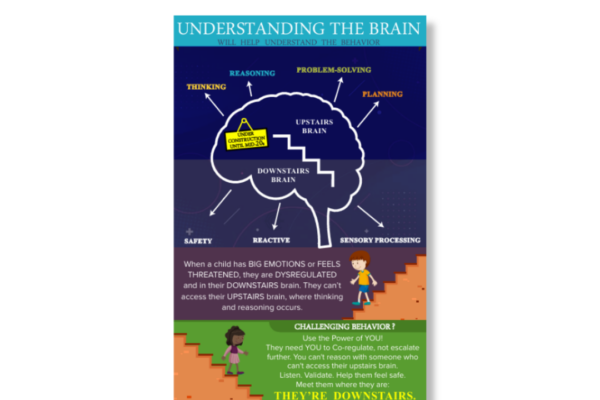
  • "Infographic by Greg Santucci, Occupational Therapist, titled 'Understanding the Brain: Will Help Understand the Behavior,' based on the concept from The Whole-Brain Child by Dr. Dan Siegel and Dr. Tina Payne Bryson. The infographic features an illustration of a brain divided into two sections. The upper section is labeled 'Upstairs Brain' and is marked with a construction sign reading 'Under Construction Until Mid-20s.' Arrows point outward from the upstairs brain to four functions: Thinking, Reasoning, Problem-Solving, and Planning. The lower section is labeled 'Downstairs Brain,' with arrows pointing outward to three functions: Safety, Reactive, and Sensory Processing. Below the brain diagram, an explanatory paragraph states that when a child has big emotions or feels threatened, they are dysregulated and in their downstairs brain, and cannot access their upstairs brain where thinking and reasoning occur. A callout section on challenging behavior states: 'Use the Power of YOU! They need you to co-regulate, not escalate further. You can't reason with someone who can't access their upstairs brain. Listen. Validate. Help them feel safe. Meet them where they are: They're Downstairs.' The infographic includes cartoon illustrations of two children on a staircase, visually representing the upstairs and downstairs brain concept."

    Upstairs Brain vs. Downstairs Brain

    FREE
    Download NowLoading Done
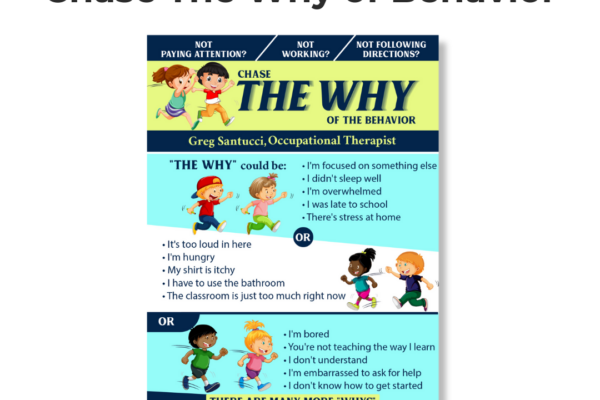
  • "Infographic by Greg Santucci, Occupational Therapist, titled 'Chase The Why of Behavior.' The infographic opens with three behavior descriptions across the top: Not Paying Attention; Not Working; Not Following Directions, followed by the prompt to chase the why of the behavior. The main section lists possible reasons behind the behavior under the heading 'The Why Could Be,' organized across three groups. The first group includes: I'm focused on something else; I didn't sleep well; I'm overwhelmed; I was late to school; There's stress at home. The second group includes: It's too loud in here; I'm hungry; My shirt is itchy; I have to use the bathroom; The classroom is just too much right now. The third group includes: I'm bored; You're not teaching the way I learn; I don't understand; I'm embarrassed to ask for help; I don't know how to get started. Below the lists, the infographic states 'There Are Many More Whys' and closes with three key reminders: The outside behavior is a signal that there's a problem on the inside; Don't react to the outside behavior — find out why the behavior is occurring; and The why is never simply attention seeking or avoiding — keep chasing."

    Chase the Why

    FREE
    Download NowLoading Done
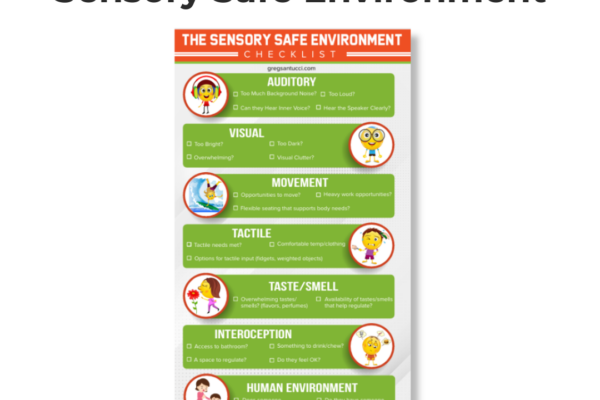
  • "Infographic from gregsantucci.com titled 'The Sensory Safe Environment Checklist.' The checklist is organized into seven sensory categories, each with checkbox items. Auditory: Too much background noise; Too loud; Can they hear inner voice; Hear the speaker clearly. Visual: Too bright; Too dark; Overwhelming; Visual clutter. Movement: Opportunities to move; Heavy work opportunities; Flexible seating that supports body needs. Tactile: Tactile needs met; Comfortable temperature and clothing; Options for tactile input such as fidgets and weighted objects. Taste and Smell: Overwhelming tastes or smells such as flavors and perfumes; Availability of tastes or smells that help regulate. Interoception: Access to bathroom; Something to drink or chew; A space to regulate; Do they feel okay. Human Environment: Does someone understand their sensory needs; Do they have someone who can help them. The checklist closes with the statement: 'A Sensory Safe Environment is Essential For Regulation and Participation.'"

    Sensory Safe Environment Checklist

    FREE
    Download NowLoading Done
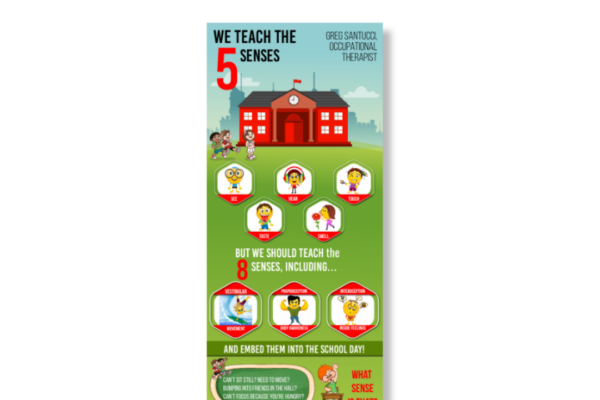
  • "Infographic by Greg Santucci, Occupational Therapist, titled 'The 8 Senses.' The infographic opens with the statement 'We Teach the 5 Senses' above an illustration of a school building, and lists the traditional five senses with cartoon icons: See, Hear, Touch, Taste, and Smell. Below these, the infographic states 'But We Should Teach the 8 Senses, Including…' and introduces three additional senses, each with an icon: Vestibular, described as movement; Proprioception, described as body awareness; and Interoception, described as inside feelings. The infographic then states 'And Embed Them Into the School Day!' followed by a callout section asking 'What Sense Is That?' with prompts including: Can't sit still? Need to move? Bumping into friends in the hall? Can't focus because you're hungry? The infographic closes with the statement: 'Let's teach kids about what they're feeling and how that impacts their behavior and learning.'"

    The 8 Senses Infographic

    FREE
    Download NowLoading Done
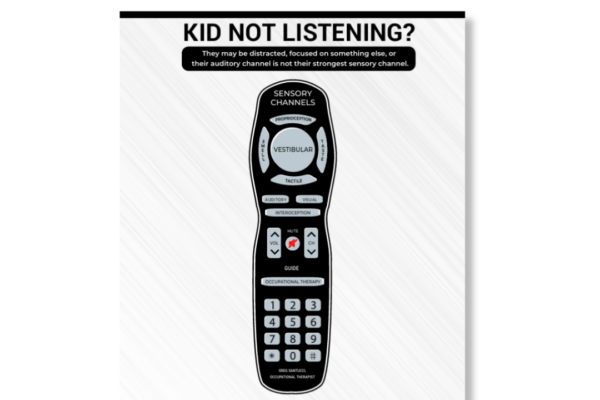
  • "Infographic by Greg Santucci, Occupational Therapist, titled 'Change The Sensory Channel.' The infographic opens with the heading 'Kid Not Listening?' followed by the explanation that the child may be distracted, focused on something else, or their auditory channel may not be their strongest sensory channel. The central illustration is a television remote control labeled 'Sensory Channels,' with the buttons on the remote representing different sensory channels: Proprioception, Vestibular, Smell, Taste, Tactile, Auditory, Visual, and Interoception, along with a Guide button labeled Occupational Therapy. The infographic closes with the statement: 'If they're not listening, change the channel! Use a different sensory channel to help them meet expectations.'"

    Change The Sensory Channel

    FREE
    Download NowLoading Done
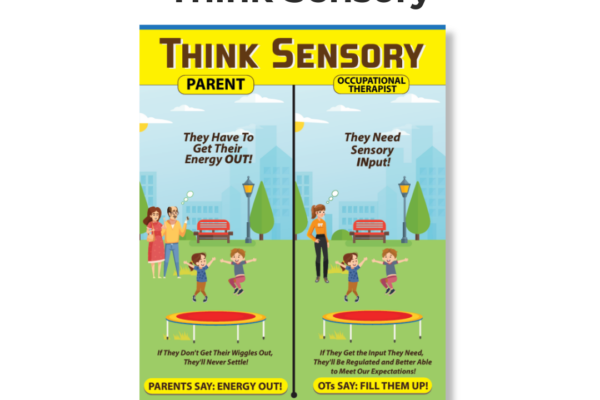
  • "Infographic titled 'Think Sensory' by Greg Santucci, Occupational Therapist, with the hashtag #ThinkSensory. The infographic is split into two side-by-side panels set in an outdoor park scene, each showing two children jumping on a trampoline. The left panel is labeled 'Parent' and states: 'They Have To Get Their Energy OUT!' with the note 'If They Don't Get Their Wiggles Out, They'll Never Settle!' summarized as 'Parents Say: Energy Out!' The right panel is labeled 'Occupational Therapist' and states: 'They Need Sensory INput!' with the note 'If They Get the Input They Need, They'll Be Regulated and Better Able to Meet Our Expectations!' summarized as 'OTs Say: Fill Them Up!' The two panels are united by a closing statement at the bottom reading: 'We're Saying the Same Thing!'"

    Think Sensory Infographic

    FREE
    Download NowLoading Done

© 2026 Think Sensory     |     Privacy Policy     |      About     |     Terms of Service

Scroll to top
  • Learn
    • Continuing Education
    • Sensory Journey Summit
    • Research Summaries
  • Explore
    • Articles
    • Videos
    • Activities
  • Connect
  • Printables
  • Learn
    • Continuing Education
    • Sensory Journey Summit
    • Research Summaries
  • Explore
    • Articles
    • Videos
    • Activities
  • Connect
  • Printables