Skip to content
Think Sensory
Join
Login
Shopping Cart 0
Shopping Cart 0
Think Sensory
Join
Login
Karla Pretorius
Karla Pretorius

Karla Pretorius

  • No ratings found yet!
  • Products
  • Reviews
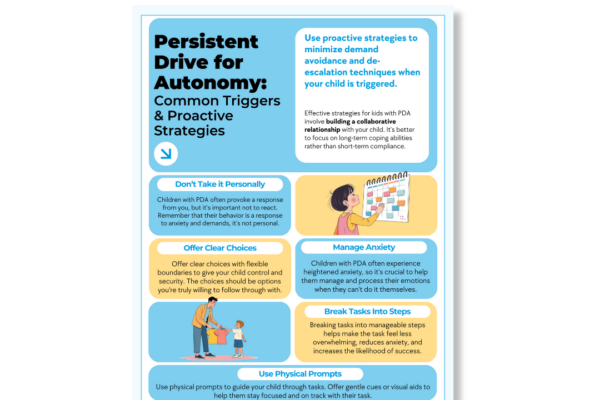
  • "Promotional graphic from ClimbRx showing a page from a PDA Information Booklet titled 'Persistent Drive for Autonomy: Common Triggers and Proactive Strategies.' The page opens with a note to use proactive strategies to minimize demand avoidance and de-escalation techniques when a child is triggered, and states that effective strategies for kids with PDA involve building a collaborative relationship, focusing on long-term coping abilities rather than short-term compliance. Five proactive strategies are presented: Don't Take it Personally — children with PDA often provoke a response, but their behavior is a response to anxiety and demands, not a personal attack; Offer Clear Choices — offer flexible choices with clear boundaries to give the child control and security, ensuring the options are ones the caregiver is truly willing to follow through with; Manage Anxiety — children with PDA often experience heightened anxiety, so it is crucial to help them manage and process their emotions when they cannot do so themselves; Break Tasks Into Steps — breaking tasks into manageable steps helps make them feel less overwhelming, reduces anxiety, and increases the likelihood of success; and Use Physical Prompts — use gentle cues or visual aids to help the child stay focused and on track with their task."

    PDA Information Booklet

    FREE
    Download NowLoading Done
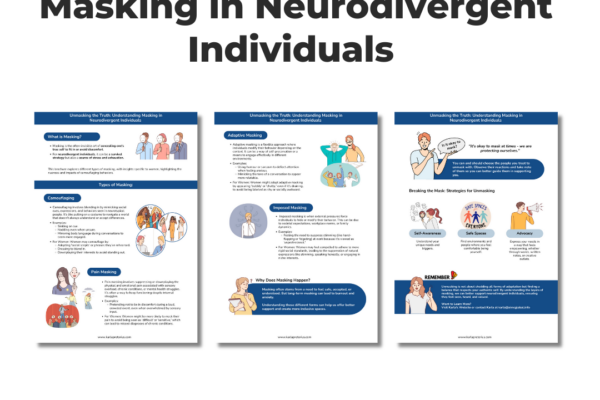
  • "Promotional graphic showing a three-page printable resource titled 'Masking in Neurodivergent Individuals: A Neurodivergent-Affirming Guide to Understanding Masking,' sourced from karlapretorius.com. The left page is titled 'Unmasking the Truth: Understanding Masking in Neurodivergent Individuals' and covers two sections: What is Masking, describing masking as the often-invisible act of concealing one's true self to fit in or avoid discomfort, noting it can be a survival strategy but also a source of stress and exhaustion; and Types of Masking, covering Camouflaging, described as blending in by mimicking social cues and behaviors seen in neurotypical people, with examples including smiling on cue, nodding when unsure, mirroring body language, using rehearsed social scripts, and downplaying interests; and Pain Masking, described as suppressing or downplaying physical and emotional pain, with a note that women may be more likely to mask in this way, potentially leading to missed diagnoses of chronic conditions. The center page covers Adaptive Masking, described as a flexible approach where individuals modify behavior depending on context as a means of self-preservation, with examples and a note about women adapting masking to avoid being labeled as shy or socially awkward; Imposed Masking, described as when external pressures force individuals to hide or modify behavior due to societal expectations or family dynamics, with a note about women feeling compelled to adhere to rigid social standards; and Why Does Masking Happen, explaining that masking often stems from a need to feel safe, accepted, or understood, but that long-term masking can lead to burnout and anxiety. The right page covers Breaking the Mask: Strategies for Unmasking, with three approaches — Self-Awareness, described as understanding your unique needs and triggers; Safe Spaces, described as finding environments and people where you feel comfortable being yourself; and Advocacy, described as expressing your needs in empowering ways through words, written notes, or creative outlets — along with a closing Remember statement noting that unmasking is about finding a balance that respects your authentic self."

    Masking in Neurodivergent Individuals

    FREE
    Download NowLoading Done
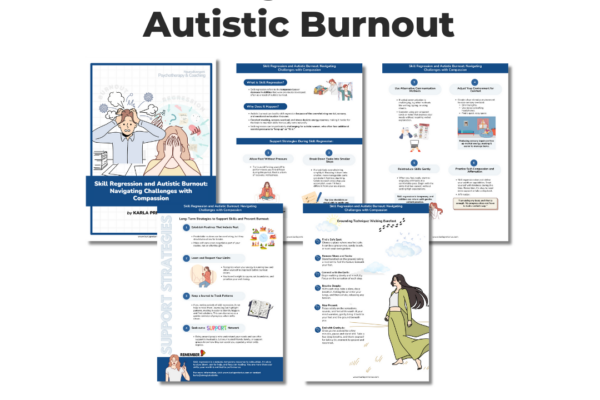
  • "Promotional graphic showing a multi-page printable resource titled 'Skill Regression and Autistic Burnout: Navigating Challenges with Compassion' by Karla Pretorius, sourced from karlapretorius.com, described at the bottom as a guide for navigating challenges with compassion. Five pages are displayed in a fanned arrangement. The cover page features an illustration of a person holding their head in distress. The second page defines skill regression as the temporary loss or decrease in abilities that were previously developed, often as a result of autistic burnout, and explains why it happens, noting that autistic burnout can lead to skill regression due to the cumulative impact of sensory, masking, and emotional exhaustion, with a note that skill regression can be particularly challenging for autistic women who often face additional societal pressures to keep up. It also covers support strategies during skill regression, including Allow Rest Without Pressure and Break Down Tasks Into Smaller Steps. The third page continues the support strategies section with Use Alternative Communication Methods, Adjust Your Environment for Comfort, Reintroduce Skills Gently, and Practice Self-Compassion and Affirmation, with a note that skill regression is temporary and kindness toward oneself can help. The fourth page covers long-term strategies to support skills and prevent burnout, including Establish Routines That Include Rest, Learn and Respect Your Limits, Keep a Journal to Track Patterns, and Seek Out a Support Network, with a closing Remember statement noting that skill regression is a setback, not a permanent response to exhaustion. The fifth page presents a Grounding Technique for Walking Burnout, with steps including finding a safe spot, removing shoes and socks, connecting with the earth, breathing deeply, staying present with sensations, and ending with gratitude."

    Skills Regression and Autistic Burnout Booklet

    FREE
    Download NowLoading Done
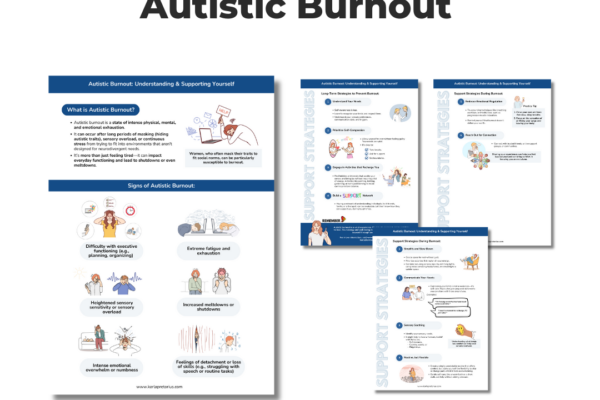
  • Here's an AOTA-compliant alt text for this image: Alt text: "Promotional graphic showing a multi-page printable resource titled 'Autistic Burnout: Understanding and Supporting Yourself,' sourced from karlapretorius.com. Four pages are displayed in a fanned arrangement. The front page covers two sections: What is Autistic Burnout, describing it as a state of intense physical, mental, and emotional exhaustion that can occur after long periods of masking autistic traits, sensory overload, or continuous stress from trying to fit into environments not designed for neurodivergent needs, noting it can impact everyday functioning and lead to shutdowns or meltdowns, with a callout noting that women who often mask their traits to fit social norms can be particularly susceptible; and Signs of Autistic Burnout, listing six signs with illustrations: difficulty with executive functioning such as planning and organizing; extreme fatigue and exhaustion; heightened sensory sensitivity or sensory overload; increased meltdowns or shutdowns; intense emotional overwhelm or numbness; and feelings of detachment or loss of skills such as struggling with speech or routine tasks. The three partially visible pages behind cover support strategies sections, including long-term strategies to prevent burnout — with topics including understanding your needs, prioritizing self-compassion, engaging in activities that recharge you, and building a support network — and support strategies during burnout, with topics including simplifying and slowing down, communicating your needs, sensory soothing, and reaching out for connection, as well as embracing emotional regulation."

    Autistic Burnout Information Booklet

    FREE
    Download NowLoading Done
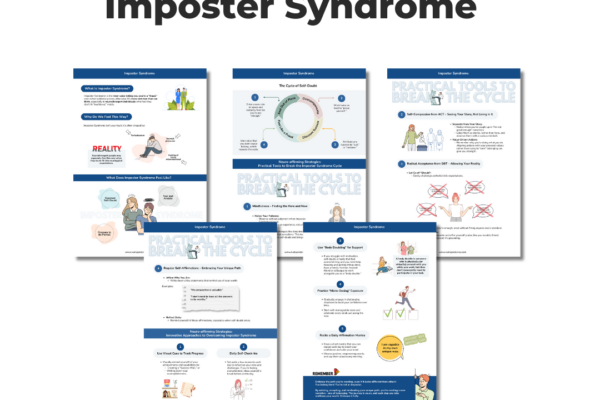
  • Here's an AOTA-compliant alt text for this image: Alt text: "Promotional graphic showing a multi-page printable resource titled 'Imposter Syndrome.' Six overlapping pages are displayed in a fanned arrangement. The pages cover the following topics: an introduction defining imposter syndrome and exploring why people feel this way, including contributing factors such as perfectionism, social pressures, and a feeling of being a fraud; a diagram illustrating the cycle of self-doubt with four stages; a section titled 'Practical Tools to Break the Cycle' covering strategies including Mindfulness — Finding the Here and Now; Self-Compassion from ACT — Seeing Your Story, Not Living in It; Radical Acceptance from DBT — Allowing Your Reality; Regular Self-Affirmations — Embracing Your Unique Path; and neuro-affirming strategies including using visual cues to track progress and daily self-check-ins; a continuation of the practical tools section covering Use Body Doubling for Support, Practice Micro-Dosing Exposure, and Recite a Daily Affirmation Mantra; and a closing reminder encouraging readers to embrace their unique path and reframe their narrative. The resource references www.hatapotamus.com as its source."

    Imposter Syndrome Information Booklet

    FREE
    Download NowLoading Done
  • Sale! "Cover page of a Parent Starter Pack titled 'Creating a Supportive Space for Your Neurodivergent Child: Tips and Templates' by Karla Pretorius, copyright 2024. A copyright notice at the bottom states the eBook is for personal use only and may not be reproduced, distributed, or transmitted without the prior written permission of the author. The background features soft watercolor-style illustrations of a sun, clouds, birds, and a rainbow."

    Creating a Calm Home for Your Neurodivergent Child

    $14.99 Original price was: $14.99.$9.99Current price is: $9.99.
    Add to cartLoading Done

© 2026 Think Sensory     |     Privacy Policy     |      About     |     Terms of Service

Scroll to top
  • Learn
    • Continuing Education
    • Sensory Journey Summit
    • Research Summaries
  • Explore
    • Articles
    • Videos
    • Activities
  • Connect
  • Printables
  • Learn
    • Continuing Education
    • Sensory Journey Summit
    • Research Summaries
  • Explore
    • Articles
    • Videos
    • Activities
  • Connect
  • Printables