Skip to content
Think Sensory
Join
Login
Shopping Cart 0
Shopping Cart 0
Think Sensory
Join
Login
Think Sensory
Think Sensory

Think Sensory

  • 5.00 rating from 1 review
    Rated 5.00 out of 5 based on 1 customer rating
  • Products
  • Reviews
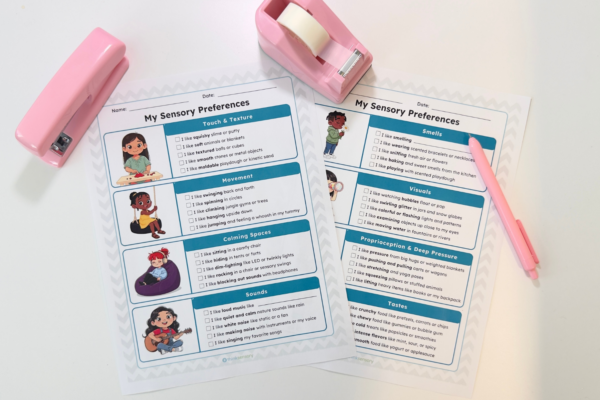
  • "A photo of two printed Think Sensory resource pages laid on a white surface, with a pink stapler, pink tape dispenser, and pink pen visible nearby. Both pages are titled 'My Sensory Preferences' with fields for name and date, and feature cartoon child illustrations alongside checkbox lists organized by sensory category. The left page covers four categories: Touch and Texture, with checkboxes for squishy slime or putty, soft animals or blankets, textured balls or cubes, smooth stones or metal objects, and moldable playdough or kinetic sand; Movement, with checkboxes for swinging back and forth, spinning in circles, climbing jungle gyms or trees, hanging upside down, and jumping and feeling a whoosh in the tummy; Calming Spaces, with checkboxes for sitting in a comfy chair, hiding in tents or forts, dim lighting like LED or twinkly lights, rocking in a chair or sensory swings, and blocking out sounds with headphones; and Sounds, with checkboxes for loud music with a write-in field, quiet and calm nature sounds like rain, white noise like static or a fan, making noise with instruments or my voice, and singing favorite songs. The right page covers four categories: Smells, with checkboxes for smelling a write-in field, wearing scented bracelets or necklaces, sniffing fresh air or flowers, baking and sweet smells from the kitchen, and playing with scented playdough; Visuals, with checkboxes for watching bubbles float or pop, swirling glitter in jars and snow globes, colorful or flashing lights and patterns, examining objects up close to my eyes, and moving water in fountains or rivers; Proprioception and Deep Pressure, with checkboxes for pressure from big hugs or weighted blankets, pushing and pulling carts or wagons, stretching and yoga poses, squeezing pillows or stuffed animals, and lifting heavy items like books or my backpack; and Tastes, with checkboxes for crunchy food like pretzels, carrots, or chips, chewy food like gummies or bubble gum, cold treats like popsicles or smoothies, intense flavors like mint, sour, or spicy, and smooth food like yogurt or applesauce."

    Sensory Preferences Checklist

    FREE
    Download NowLoading Done
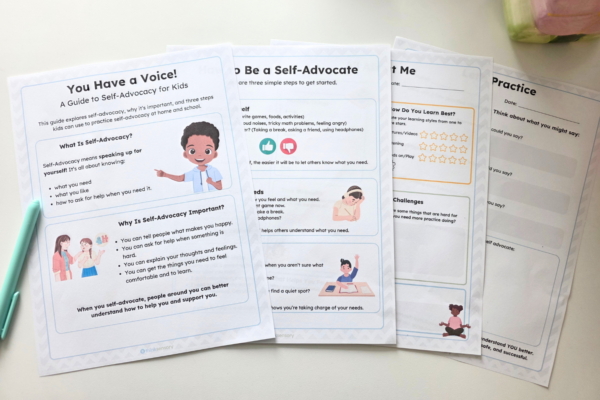
  • Self-Advocacy Guide for Kids

    Self-Advocacy Guide for Kids

    FREE
    Download NowLoading Done
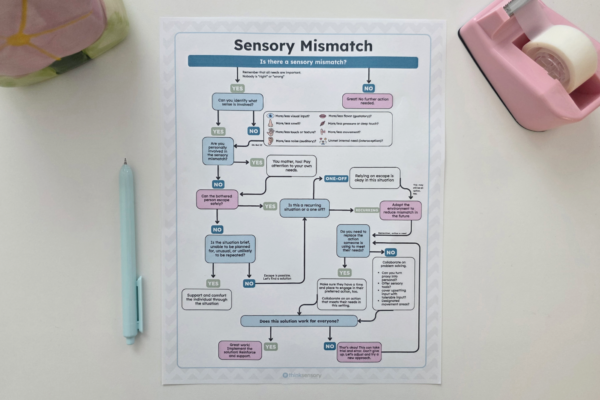
  • "A photo of a printed Think Sensory resource page laid flat on a white surface, with a light blue pen and a pink tape dispenser visible nearby. The page is titled 'Sensory Mismatch' and features a detailed flowchart for navigating sensory mismatch situations, beginning with the question 'Is there a sensory mismatch?' with a note that all needs are important and nobody is right or wrong. The flowchart branches as follows: If No — Great, no further action needed. If Yes — Can you identify what sense is involved? A list of possible sensory areas is provided, including visual, smell, touch or texture, auditory, gustatory or flavor, pressure or deep touch, movement, and unmet internal need or interoception. If the sense can be identified and the caregiver is personally involved in the mismatch, the flowchart prompts them to pay attention to their own needs too. If the caregiver is not involved, the next question is whether the bothered person can escape safely. If Yes — Is this a recurring situation or a one-off? If one-off, relying on escape is noted as acceptable, with the option to also adapt the environment for the future. If recurring, the flowchart asks whether the action someone is using to meet their needs needs to be replaced. If No, the path leads to collaborative problem solving, with suggested strategies including turning a proxy into something personal, offering sensory tools, covering upsetting input with tolerable input, and designating movement areas. If Yes, the path leads to ensuring the person has a time and place to engage in their preferred action and collaborating on an action that meets their needs in the setting. If the person cannot escape safely, the next question is whether the situation is brief, unplanned, unusual, or unlikely to be repeated. If Yes, support and comfort the individual through the situation. If No, escape is noted as possible and the prompt is to find a solution. All paths lead to the final question: Does this solution work for everyone? If Yes — implement, reinforce, and support the solution. If No — that is okay, this can take trial and error, adjust and try a new approach."

    Sensory Mismatch Flowchart

    Rated 5.00 out of 5
    FREE
    Download NowLoading Done
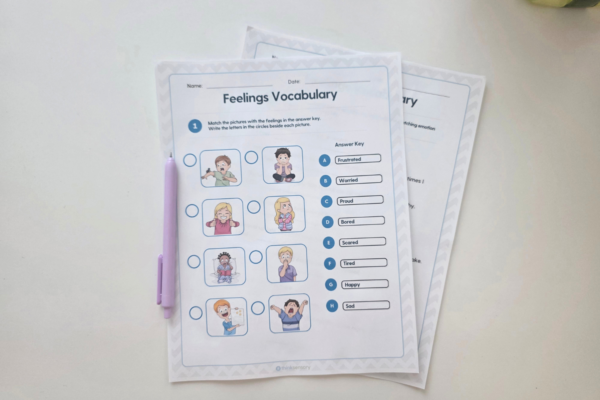
  • Feelings Vocabulary Worksheet

    Feelings Vocabulary Worksheet

    FREE
    Download NowLoading Done
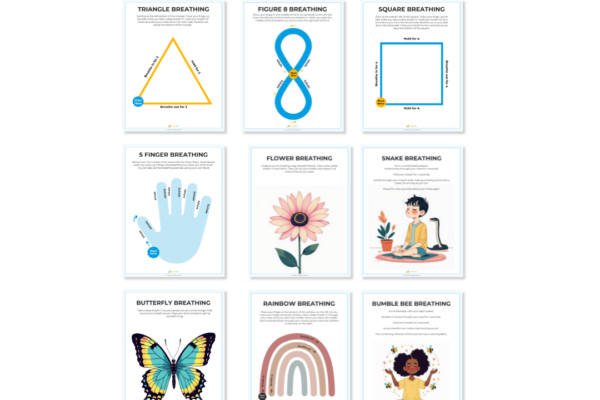
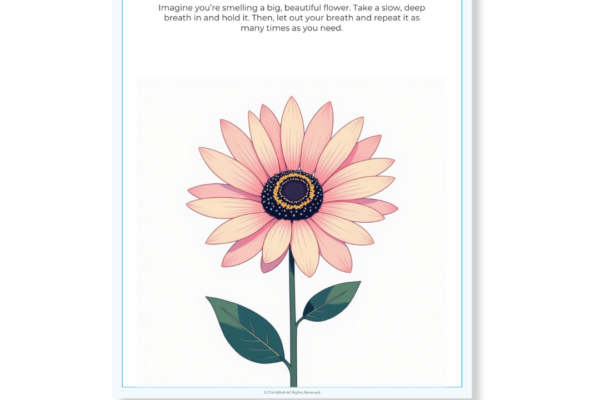
  • "Promotional graphic from ClimbRx showing a resource titled 'Deep Breathing Activities,' described as 9 printable deep breathing activities for kids. All nine activity pages are displayed in a three-by-three grid, each featuring a visual guide and instructions for a different breathing technique. The nine activities are: Triangle Breathing, where a child traces a triangle shape, breathing in for 3, holding for 3, and breathing out for 3; Figure 8 Breathing, where a child traces a figure-eight shape, breathing in on one loop and out on the other; Square Breathing, where a child traces a square, breathing in for 4, holding for 4, breathing out for 4, and holding for 4 on each side; 5 Finger Breathing, where a child traces the outside of their hand with one finger, breathing in as they trace up each finger and out as they trace down, illustrated with a hand outline; Flower Breathing, where a child imagines smelling a flower, taking a slow deep breath in and then exhaling, repeated as many times as needed, illustrated with a flower; Snake Breathing, where a child inhales slowly through the nose, holds briefly, then exhales through the mouth making a hissing sound like a snake, illustrated with a child meditating beside a snake; Butterfly Breathing, where a child takes a deep breath in while stretching arms wide and breathes out while bringing arms in to give themselves a hug, illustrated with a butterfly; Rainbow Breathing, where a child traces a finger along the arc of a rainbow while breathing in through the nose and out through the mouth, illustrated with a rainbow; and Bumble Bee Breathing, where a child sits comfortably, inhales for 4 seconds, holds for 4 seconds, then exhales while making a humming sound, with a note that the vibration has a calming effect, illustrated with a child meditating surrounded by bees."

    Deep Breathing Activities for Kids

    FREE
    Download NowLoading Done
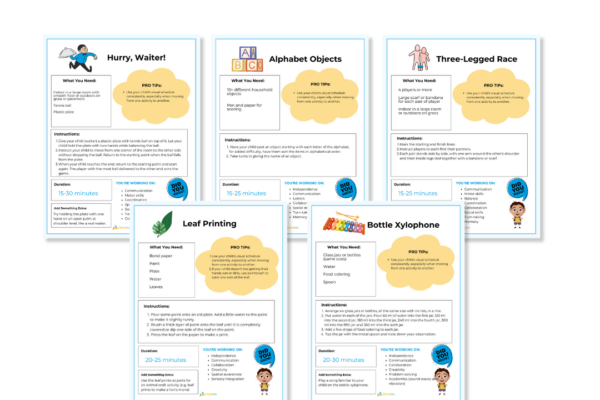
  • "Promotional graphic from ClimbRx showing a resource titled 'Skill-Building Activity Maps,' described as engaging hands-on activities for practicing essential skills. Five activity map pages are displayed. Each page follows the same format, including a title, what you need, pro tips recommending the use of a child's visual schedule when moving between activities, step-by-step instructions, duration, a list of skills being worked on, and an Add Something Extra extension idea. The five activities are: Hurry Waiter, a 15 to 30 minute balancing game where a child carries a plastic plate with a tennis ball across a room without dropping it, working on communication, motor skills, and coordination; Alphabet Objects, a 15 to 25 minute game where a child spots household objects starting with each letter of the alphabet, working on independence, communication, letters, collaboration, social skills, turn-taking, and memory; Three-Legged Race, a 15 to 25 minute partnered outdoor or indoor race where pairs stand side by side with one arm around each other and inside legs tied together with a bandana, working on communication, motor skills, balance, coordination, collaboration, social skills, turn-taking, and memory; Leaf Printing, a 20 to 25 minute art activity where a child paints a leaf and presses it onto paper to make a print, working on independence, communication, collaboration, creativity, spatial awareness, and sensory integration, with an extension to use the leaf prints to make an animal craft; and Bottle Xylophone, a 20 to 30 minute science and music activity where six glass jars or bottles are filled with varying amounts of water and food coloring and tapped with a spoon to observe sound differences, working on independence, communication, collaboration, creativity, problem solving, and academics including sound waves and vibration, with an extension to play a familiar song on the bottle xylophone."

    Skill-Building Activity Maps

    FREE
    Download NowLoading Done
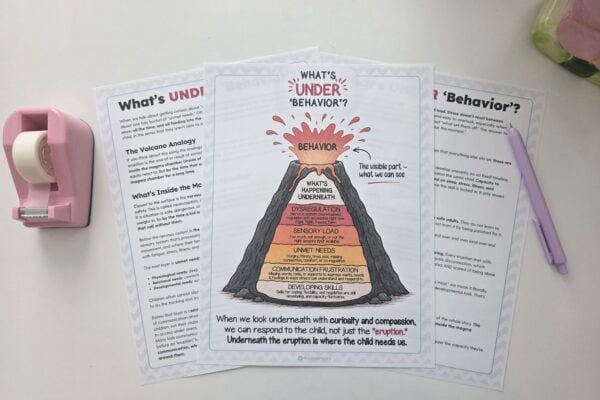
  • "A photo of three printed Think Sensory resource pages fanned out on a white surface, with a pink tape dispenser and a purple pen visible nearby. The center page is fully visible and titled 'What's Under Behavior?' It features an illustrated volcano diagram where the erupting lava at the top is labeled 'Behavior' with the note 'the visible part — what we can see.' The layers inside the volcano, from top to bottom, represent what is happening underneath: Dysregulation, described as the nervous system being overwhelmed and regulation not being accessible, with fight, flight, freeze, or fawn responses; Sensory Load, described as too much, not enough, or the wrong sensory input; Unmet Needs, including hunger, thirst, tiredness, illness, and missing connection, comfort, or co-regulation; Communication Frustration, described as missing words, tools, or supports to express wants, needs, and feelings; and Developing Skills, noting that skills for coping, flexibility, and regulation are still developing and capacity fluctuates. Below the diagram, the page reads: 'When we look underneath with curiosity and compassion, we can respond to the child, not just the eruption. Underneath the eruption is where the child needs us.' The two pages behind the center page are partially visible and appear to contain related explanatory text under the same title."

    What’s Under Behavior?

    FREE
    Download NowLoading Done
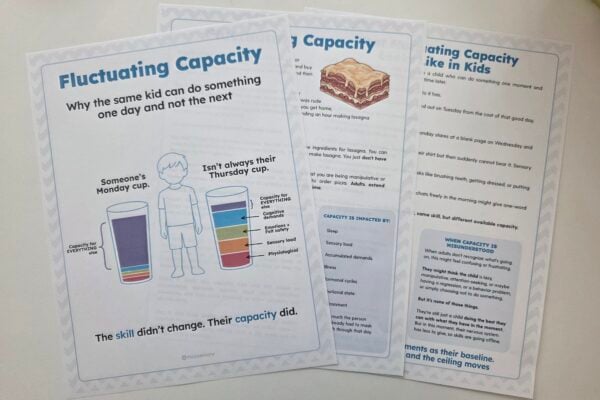
  • "A photo of three printed Think Sensory resource pages fanned out on a white surface. The front page is fully visible and titled 'Fluctuating Capacity: Why the same kid can do something one day and not the next.' It features two illustrated cup diagrams flanking a simple drawing of a child. The left cup, labeled 'Someone's Monday cup,' is mostly filled with a large purple section at the bottom labeled 'Capacity for everything else,' with thin colored layers above it. The right cup, labeled 'Isn't always their Thursday cup,' shows the same cup divided into more layers from bottom to top: Physiological, Sensory load, Emotions and felt safety, Cognitive demands, and Capacity for everything else — with each layer taking up more of the cup, leaving less room at the top. The closing statement reads: 'The skill didn't change. Their capacity did.' The two pages behind are partially visible. The middle page shows a partially visible list under the heading 'Capacity is impacted by,' including sleep, sensory load, accumulated demands, illness, hormonal cycles, emotional state, and environment. The rightmost page is partially visible with a heading referencing 'Fluctuating Capacity in Kids' and a callout box titled 'When Capacity is Misunderstood,' which notes that when adults don't recognize what's going on, they might think the child is lazy, manipulative, attention-seeking, or having a regression, but states it is none of those things — the child is doing the best they can with what they have in the moment."

    Fluctuating Capacity Info Sheet

    FREE
    Download NowLoading Done
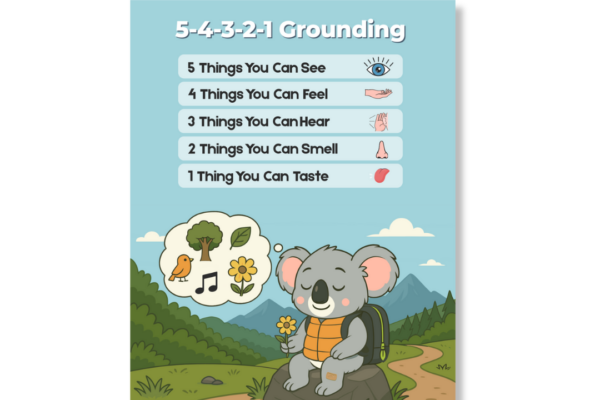
  • "Printable poster from ClimbRx titled '5-4-3-2-1 Grounding.' The poster lists five grounding steps, each paired with a small sensory icon: 5 Things You Can See; 4 Things You Can Feel; 3 Things You Can Hear; 2 Things You Can Smell; and 1 Thing You Can Taste. Below the steps, an illustration shows a cartoon koala sitting on a rock in an outdoor nature scene, wearing a backpack and holding a flower, with a thought bubble containing images of a tree, a bird, a musical note, and a sunflower."

    5-4-3-2-1 Grounding

    FREE
    Download NowLoading Done
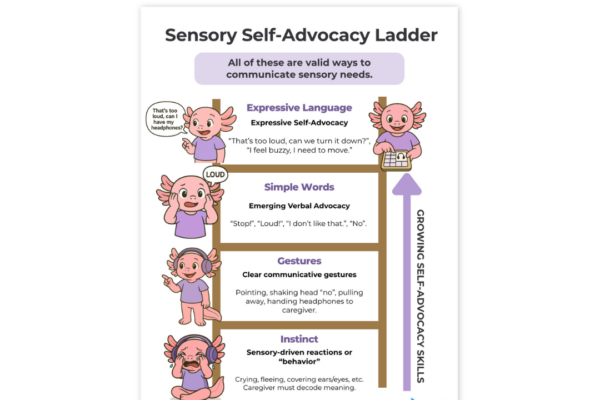
  • "Printable poster from ClimbRx titled 'Sensory Self-Advocacy Ladder,' with the note that all of these are valid ways to communicate sensory needs. The poster displays a ladder diagram with four rungs, each illustrated by a cartoon axolotl character in a different state, and an upward arrow on the right labeled 'Growing Self-Advocacy Skills.' From bottom to top: Instinct — described as sensory-driven reactions or behavior, with examples including crying, fleeing, and covering ears or eyes, noting the caregiver must decode meaning; Gestures — described as clear communicative gestures, with examples including pointing, shaking head no, pulling away, and handing headphones to a caregiver; Simple Words — described as emerging verbal advocacy, with examples including 'Stop!', 'Loud!', 'I don't like that,' and 'No'; and Expressive Language — described as expressive self-advocacy, with examples including 'That's too loud, can we turn it down?' and 'I feel buzzy, I need to move.'"

    Sensory Self-Advocacy Ladder Poster

    FREE
    Download NowLoading Done
  • "Promotional graphic from ClimbRx showing two pages of a printable resource for care providers titled 'Sensory Information Sheet.' The left page includes fields for the child's name and age, followed by four sections: Strengths and Interests, with a prompt to list things the child enjoys or excels at and a blank write-in area; Sensory Preferences, described as sensory inputs the child enjoys or seeks out, with checkboxes for deep pressure such as weighted blankets and hugs, movement such as jumping, spinning, and swinging, tactile input such as playing with textures and fidget toys, oral input such as chewing gum and sucking on straws, visual input such as watching moving lights, patterns, or spinning objects, and an open Other field; Sensory Challenges, described as sensory inputs that may be overwhelming or distressing, with checkboxes for loud noises such as sirens, alarms, and crowded places, bright lights such as fluorescent lighting and sunlight, unexpected touch such as light touches and crowded spaces, strong smells such as perfumes and cleaning products, certain textures such as clothing materials and food textures, and an open Other field; and Signs to Watch For, with a prompt noting that when overwhelmed the child may show the following signs, followed by a blank write-in area. The right page contains three sections: Strategies and Supports, described as accommodations or strategies that help the child regulate and feel comfortable, with a large blank write-in area; Communication, described as how the child communicates their needs best, with checkboxes for speaking, gestures or pointing, visual aids or communication cards, AAC device, and an open Other field; and Notes or Special Considerations, with a blank write-in area."

    Sensory Information Sheet

    FREE
    Download NowLoading Done
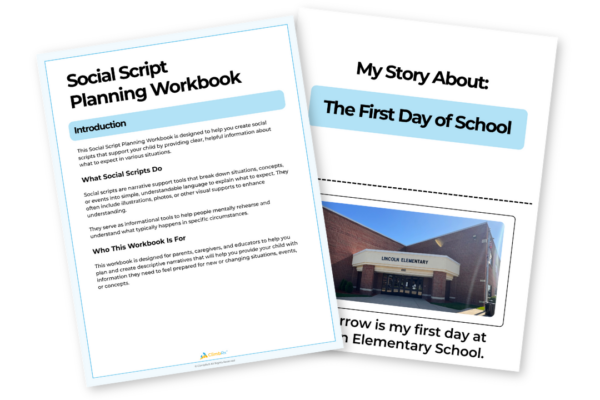
  • "Promotional graphic from ClimbRx showing two pages from a resource described at the bottom as a Fillable PDF Planner and Drag-and-Drop Story Template. The left page is titled 'Social Script Planning Workbook' and contains three sections: an Introduction explaining that the workbook helps caregivers create social scripts that support children by providing clear, helpful information about what to expect in various situations; What Social Scripts Do, describing social scripts as narrative support tools that break down situations, concepts, or events into simple understandable language, often with illustrations or photos, to help people mentally rehearse and understand what typically happens in specific circumstances; and Who This Workbook Is For, noting it is designed for parents, caregivers, and educators to help plan and create descriptive narratives that prepare children for new or changing situations, events, or concepts. The right page shows a sample completed social script titled 'My Story About: The First Day of School,' featuring a photograph of a brick school building with a sign reading Lincoln Elementary, and partial text reading 'Tomorrow is my first day at Lincoln Elementary School.'"

    Social Script Planning Workbook

    FREE
    Download NowLoading Done
  • ← Previous
  • 1
  • 2
  • 3
  • Next →
  • »

© 2026 Think Sensory     |     Privacy Policy     |      About     |     Terms of Service

Scroll to top
  • Learn
    • Continuing Education
    • Sensory Journey Summit
    • Research Summaries
  • Explore
    • Articles
    • Videos
    • Activities
  • Connect
  • Printables
  • Learn
    • Continuing Education
    • Sensory Journey Summit
    • Research Summaries
  • Explore
    • Articles
    • Videos
    • Activities
  • Connect
  • Printables