
Sensory Processing & Sensory Mismatch
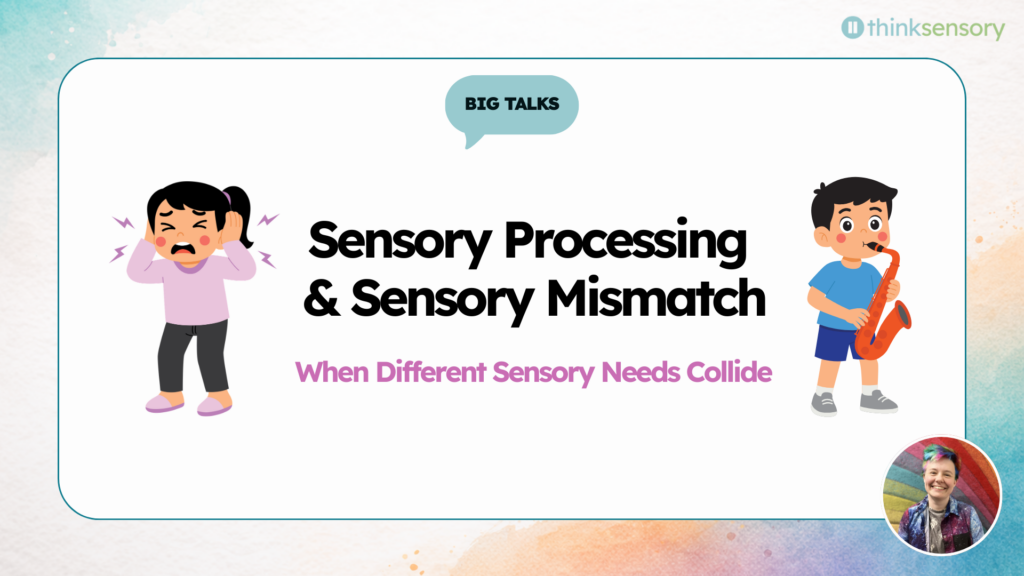
Every person processes sensory information differently, and when two people sharing the same space need opposite things from their environment, it creates one of the most common challenges parents, educators, and therapists face. This course teaches you about sensory mismatch and gives you practical tools and strategies for recognizing and resolving sensory mismatches.
 Kelsie Mick Olds, MOT OTR/L
Enrollment Options

Professional Track
Provides a certificate of completion for 1.25 continuing education contact hours. Designed for social workers, educators, and early childhood educators looking to earn CE credit for professional development.
This course provides 0.125 General CEUs or 1.25 contact hours

Personal Track
Designed for parents, caregivers, and educators looking to deepen their knowledge and understanding and learn practical strategies for supporting neurodivergent children.
Professional Track
- Big Talks Little Talks Video Course
- PDF Companion Notes
- Learning outcomes assessment
- Certificate of completion for 0.125 General CEUs
Personal Track
- Big Talks Little Talks video course
- PDF Companion Notes
Meet Your Instructor
Kelsie Mick Olds, MOT OTR/L
Mick is an occupational therapist working both on- and offline to share knowledge widely about the ways that children grow, develop, and learn. Mick is passionate about play as the core meaningful occupation that underlies childhood, and about equipping adults with the education and practical tools they need to defend children’s right to play.
Mick has a Master of Occupational Therapy degree from the University of Oklahoma and has worked primarily in schools, as well as consulting with teachers, therapists, and parents to advocate on children’s behalf. Mick blogs as The OccuPLAYtional Therapist.
About This Course
What Is Sensory Mismatch?
Every person processes sensory information differently. What feels calming to one person can feel overwhelming to another.
Sensory mismatch happens when two people sharing the same space need opposite things from their environment: one child needs to move, another needs stillness. One needs the lights on, another needs them off. One needs to make noise to focus, another needs silence to think.
These situations come up constantly in classrooms, therapy rooms, and homes, and they're one of the most common challenges that parents, educators, and therapists face when supporting neurodivergent children.
Why Sensory Mismatch Is So Hard to Navigate
You've probably been here before. Two kids are sharing a space, and one needs something the other can't tolerate. One child is humming to focus and the other can't think through the noise. You can see the conflict, but you're not sure what to do next.
Often the easiest move is to go with whatever matches your own sensory preference, or to ask one child to push through it. But that leaves one person's needs unmet, and over time it can lead to increased dysregulation, damaged trust, and fewer opportunities for real problem-solving.
This course walks you through how to identify sensory mismatches, understand what's driving each person's needs, and build strategies that honor both sides of the conflict.
Big Talks, Little Talks
Understanding How Kids Think, Feel, and Behave — One Talk at a Time

Sensory Processing & Sensory Mismatch is one of eight modules in Big Talks, Little Talks, a video course series by Kelsie Mick Olds covering key topics in neurodiversity and child development. Modules can be purchased individually or as a complete bundle.
Every module in the series includes two videos:
The professional development component. Kelsie walks through the topic in depth, giving you the knowledge and language to understand what's happening and how to respond. Big Talks run approximately one hour and qualify for continuing education credit.
A kid-friendly video that gives children accessible language to understand what's going on in their own bodies and brains. You can show it directly to a child, break it into shorter chunks across multiple sessions, or watch it yourself to pick up language you can use in your own conversations.
Who Is This Course For?
This course is designed for therapists, parents, caregivers, educators, early childhood educators, and anyone who works with or lives with children who have different sensory needs.
Whether you're managing a classroom where one student hums to focus and another can't tolerate the sound, or you're at home with two kids who want opposite things from the same room, this course gives you practical tools you can use right away.
Course Details
Select a track to view what's included.
Course Modules
Big Talks: Sensory Processing & Sensory Mismatch
01:03:37This Big Talk introduces the concept of sensory mismatch and examines what happens when two people in the same space have opposing sensory needs.
Presenter Kelsie Mick Olds, OTR/L, opens with real examples across classroom, therapy, and home settings, and explains why defaulting to the adult’s preference is not sufficient problem solving.
The video introduces a distinction between proxy senses and personal senses, and walks through four practical tools for managing mismatch across a range of environments. The talk closes with a reminder that two different sensory needs do not automatically create a competition, and that adults are partners in the problem-solving process rather than the deciding vote.
Little Talks: Making My “Bubble” the Way I Like It
00:17:14This Little Talk introduces kids to the concept of sensory mismatch — what happens when two people sharing a space need opposite things from their senses. Kelsie explains that everyone’s sensory experience is personal and unique, and walks through practical strategies for protecting your own bubble without popping someone else’s, including finding ways to get your needs met that don’t affect the people around you.
The talk closes with an encouragement for kids to build language for what they feel inside their bodies, to seek out their own space when they need full control over their environment, and to believe themselves when their body tells them something.
What's Included
Course Content
Registration Information
To register, select your preferred course option on this page and complete your purchase. Access to all course materials is granted immediately upon completion of payment. If you require accommodations or have special needs requests, please contact us at ce@thinksensory.com.
Course Modules
Big Talks: Sensory Processing & Sensory Mismatch
01:03:37This Big Talk introduces the concept of sensory mismatch and examines what happens when two people in the same space have opposing sensory needs.
Presenter Kelsie Mick Olds, OTR/L, opens with real examples across classroom, therapy, and home settings, and explains why defaulting to the adult’s preference is not sufficient problem solving.
The video introduces a distinction between proxy senses and personal senses, and walks through four practical tools for managing mismatch across a range of environments. The talk closes with a reminder that two different sensory needs do not automatically create a competition, and that adults are partners in the problem-solving process rather than the deciding vote.
Little Talks: Making My “Bubble” the Way I Like It
00:17:14This Little Talk introduces kids to the concept of sensory mismatch — what happens when two people sharing a space need opposite things from their senses. Kelsie explains that everyone’s sensory experience is personal and unique, and walks through practical strategies for protecting your own bubble without popping someone else’s, including finding ways to get your needs met that don’t affect the people around you.
The talk closes with an encouragement for kids to build language for what they feel inside their bodies, to seek out their own space when they need full control over their environment, and to believe themselves when their body tells them something.
What's Included
Course Content
Registration Information
To register, select your preferred course option on this page and complete your purchase. Access to all course materials is granted immediately upon completion of payment. If you require accommodations or have special needs requests, please contact us at ce@thinksensory.com.
Learning Outcomes
Upon completion of this course, participants should be able to:
- Define sensory mismatch and explain why defaulting to the preferences of adults or the majority does not constitute sufficient problem solving.
- Identify the distinction between proxy senses and personal senses, and explain how this distinction informs an initial approach to resolving a mismatch.
- Explain the principle that a child’s behavior is not the same as the underlying sensory need, and describe how identifying the need opens additional problem-solving options.
- Describe the four tools for managing sensory mismatch and explain how each can be applied across classroom, therapy, and home settings.
Continuing Education Details
Sensory Processing & Sensory Mismatch
Video lecture with slide presentation, optional companion notes document, and optional sensory mismatch flowchart printable/visual.
To receive 0.125 CEUs (1.25 contact hours) for this activity, you must complete all of the following:
- View all required video content in its entirety.
- Pass the post-activity learning outcome assessment with a score of 80% or higher.
- Complete the post-activity evaluation.
Partial credit is not available. You must complete all requirements listed above to receive CEUs and a certificate of completion.
If you do not achieve a passing score of 80% on the learning outcome assessment, you may retake the assessment. There is no limit on retake attempts.
Mick was paid for their contributions to Goal Writing for Autistic Students. Mick receives commission for the sales of Big Talks Little Talks. Mick is the author of a book, “Your Child’s Point of View: Understanding the Reasons Kids Do Unreasonable Things” and receives royalties for its’ sale. Mick is the owner of The OccuPLAYtional Therapist and receives speaking fees.
Mick is Autistic and has friends and family members who are Autistic.
Think Sensory will issue a full refund to a learner who requests cancellation within 10 calendar days of purchase, provided the learner has not accessed any course content. Once any course content has been accessed, no refund will be issued, regardless of how much of the activity has been completed. Due to the digital nature of CEU-eligible PD activities, Think Sensory does not offer partial refunds after content has been accessed.
If Think Sensory cancels or removes a course from the platform, affected learners will be notified in advance and provided with an appropriate remedy. For full details, see our Terms of Service.
To request a cancellation, email ce@thinksensory.com.